|
 |
 | | | | | | |||||||||||||||||||||||||||||||||||||||||||||||||||||||||||||||||||||||||||||||||||||||||||||||||||||||||||||||||||||||||||||||||||||||||||||||||||||||
| | | You are in: Business | |||||||||||||||||||||||||||||||||||||||||||||||||||||||||||||||||||||||||||||||||||||||||||||||||||||||||||||||||||||||||||||||||||||||||||||||||||||||||
|
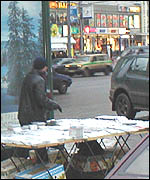
| | Tuesday, 7 January, 2003, 14:08 GMT Russia battles against CD piracy  Pirate CDs can be found everywhere in Moscow
Several buyers are browsing his wares, displayed on a folding table just five minutes walk from the seat of the Russian government, in the centre of Moscow. But what he is selling causes a terrible headache for the government, not to mention international recording companies, the World Trade Organisation (WTO) and law enforcement agencies in Russia and abroad.
Each of them costs just slightly more than a pound - so it is no wonder that buyers are in abundance. Police turn a blind eye on the merchandise - "All was settled down by my bosses," grins Maxim. He is one of tens of thousands involved in this business, whose profits are second only to drugs smuggling and arms sales. Russia has the second largest music piracy market in the world, after China, according to the International Federation of the Phonographic Industry (IFPI), the organisation representing the recording industry worldwide. It also has one of the highest piracy rates in the world at 65%. More troubling is that the 200 million pirated CDs produced in Russia dwarf the country's total market for CDs by eight times. Pirated CDs made in Russia are smuggled to the Western Europe and can be found in Paris, London and Amsterdam. Roots in communism The clandestine recording industry emerged in Russia some 30 years ago. During the Soviet years the only state recording company Melodia, following the lead of the Communist Party, pretended that neither The Beatles nor The Rolling Stones existed.
After the fall of communism, the bootleggers snatched the Melodia's producing facilities and started a new industry, filling shops with pirated LPs and CDs. Many were badly recorded and packed in sleeves with illegible pictures. In 1992 the Gorbunov market opened in the west of Moscow, and went on to become the largest pirated audio and video market in the world. International interests As the sales increased in the second half of the 1990s, so did piracy. By the end of the century, copyright holders will be losing half a billion dollars annually in Russia due to piracy, according to the International Phonogram Producers Association.
Earlier this year the US ambassador to Russia asked Moscow to be more active in fighting piracy. In a letter addressed to the Russia's government he listed a number of clandestine factories, most of them located in classified areas. The government responded by organising several committees and task forces, but the situation has not improved a great deal. Embarrassment Moscow would like to see the problem gone. Tax revenues from CD sales account for merely $3m a year, but could rake in as much as $120m if the total market was taken into account, according to government sources.
The issue of copyrights and protection of the intellectual property is a sensitive issue, blocking Russia's accession to the WTO. And there is always a threat of trade sanctions, like the ones imposed on the neighbouring Ukraine by the US for not adopting the copyright protection laws. Piracy is welcome However, various Russian politicians and industrialists accuse the government of bowing to pressure from international media companies at the expense of Russia's own domestic industry. They also argue that Russians should not be expected to pay the same price for a CD as Westerners do. Some of the international recording companies accept this argument - Polygram launched a special Russian edition of its most popular albums with simplified design, which costs a fraction of its Western retail price. But this doesn't solve the problem. Many believe that piracy has wealthy and powerful defenders in Moscow. "This problem like so many others can be resolved should the state really want it," says Andrei Gavrilov, a veteran of the country's music industry and boss of Solid Records recording company. "Piracy was subdued, if not eliminated in the Czech Republic and Poland," he adds. Russia's producers argue that the battle against piracy can only be won through joint action by the recording giants - offering acceptable prices for the Russian market - and by the government's strict enforcement of law. But progress is slow, and piracy was certainly winning the day during the run-up to Christmas at Maxim's stall, five minutes walk from largest CD shop in central Moscow. | | See also:  11 Oct 02 | Entertainment 11 Jun 02 | Entertainment 26 Feb 02 | Entertainment 17 Jan 02 | Business 21 Dec 01 | Americas Internet links: The BBC is not responsible for the content of external internet sites Top Business stories now: Links to more Business stories are at the foot of the page. | |||||||||||||||||||||||||||||||||||||||||||||||||||||||||||||||||||||||||||||||||||||||||||||||||||||||||||||||||||||||||||||||||||||||||||||||||||||||
 | |
|  E-mail this story to a friend E-mail this story to a friend |
| |
| Links to more Business stories |
| | | ||
 | ||||
 | | Back to top
| ||
| ---------------------------------------------------------------------------------- To BBC Sport>> | To BBC Weather>> | To BBC World Service>> ---------------------------------------------------------------------------------- © MMIII | News Sources | Privacy |






 All was settled down by my bosses