|
 |
 | | | | | | ||||||||||||||||||||||||||||||||||||||||||||||||||||||||||||||||||||||||||||||||||||||||||||||||||||||||||||||||||||||||||||||||||||||||||||||||||||||||
| | | You are in: Business | ||||||||||||||||||||||||||||||||||||||||||||||||||||||||||||||||||||||||||||||||||||||||||||||||||||||||||||||||||||||||||||||||||||||||||||||||||||||||||
|
| | Thursday, 5 September, 2002, 13:36 GMT 14:36 UK Investors bet on hi-tech breakthrough 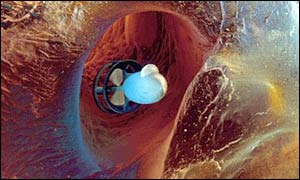 A micro-submarine in an artery �Science Photo Library
There has certainly been little to cheer investors lately, but that does not prevent them from looking for the next big thing.
But researchers say the real promise of nanotechnology will take years of hard work in the lab. They fear that if it is over-hyped, their work could fall victim to the sort of boom and bust cycle that has hit telecoms and dot.com businesses. It sounds like science fiction, but researchers are predicting:
'Hype-fed charlatans' Corporate investors and venture capitalists have doubled their investments in nanotech over the past two years, with $1bn (�640m) flowing into nano projects, according to Josh Wolfe, partner with the Lux Capital Group. Mr Wolfe says that people are as excited about nanotechnology now as they were about the internet back in the early 1990s.
And just as new companies slapped a dot.com on their name to take advantage of the internet investment frenzy, so they are starting to add nano to their names to ride this wave. According to Mr Wolfe, some of the businesses now making claims on nanotech are little more than "hype-fed charlatans" and do not even have true nanoscale products. "The only people making money today on nanotechnology are conference planners," he said. Not enough time Computer makers have a tremendous interest in nanotechnology. Smaller and smaller transistors and microprocessors have already fuelled a cycle of ever-faster, more powerful computers.
But some scientists predict the trend is now coming to an end and traditional silicon technology will reach its physical and economic limit by 2012. Chris Murray at IBM and Dr R Stanley Williams at Hewlett Packard are racing to overcome these limitations, using nano techniques to continue to shrink computer circuits. IBM is working with carbon nanotubes to replace silicon in transistors and Dr Williams, in a joint project with UCLA, has developed memory chips using molecular switches. But the big problem is time. Something that takes advantage of a new discovery in the lab generally takes 10 to 15 years to make it to the market, according to Mr Murray. "If it's revolutionary, it truly takes patience," he said. "Most people selling on shorter time periods are either not presenting something truly revolutionary or not telling the full story," he added. Definitive breakthrough Mr Williams said that nanoelectronics was where microelectronics was in 1960. And revolutionary advances in might be 10 years or even decades away - not years away as some nanotech enthusiasts predict. He fears that those who bet on nanotech stocks in the hope a quick return might be disappointed or worse - fuelling a backlash that could see government research funding slashed. "If too much venture money and investment rushes in too quickly, people get burned, and the whole field gets a black mark," Mr Williams said. But it is a fine line. "Hype is good, it is a lubricant for capital flows," said Mr Wolfe. Those who are working with nanotechnology need money for research but they cannot say how long it will take to deliver their computer revolution. "This will be the definitive breakthrough of this century. There will very real economic changes," said Mr Wolfe. "The question is how soon." | | See also:  18 Aug 02 | Technology 23 Aug 02 | Technology 21 Sep 01 | Science/Nature Internet links: The BBC is not responsible for the content of external internet sites Top Business stories now: Links to more Business stories are at the foot of the page. | ||||||||||||||||||||||||||||||||||||||||||||||||||||||||||||||||||||||||||||||||||||||||||||||||||||||||||||||||||||||||||||||||||||||||||||||||||||||||
| |
|  E-mail this story to a friend E-mail this story to a friend |
| |
| Links to more Business stories |
| | | ||
 | ||||
 | | Back to top
| ||
| ---------------------------------------------------------------------------------- To BBC Sport>> | To BBC Weather>> | To BBC World Service>> ---------------------------------------------------------------------------------- © MMIII | News Sources | Privacy |