|
 |
 | | | | | | |||||||||||||||||||||||||||||||||||||||||||||||||||||||||||||||||||||||||||||||||||||||||||||||||||||||||||||||||||||||||||||||||||||||||||||||||||||||||||||||||||||||||||||||||||||||||||||||||||||||||||||||||||||
| | | You are in: Business | |||||||||||||||||||||||||||||||||||||||||||||||||||||||||||||||||||||||||||||||||||||||||||||||||||||||||||||||||||||||||||||||||||||||||||||||||||||||||||||||||||||||||||||||||||||||||||||||||||||||||||||||||||||||
|
| | Tuesday, 13 August, 2002, 15:21 GMT 16:21 UK Situation in Argentina set to worsen 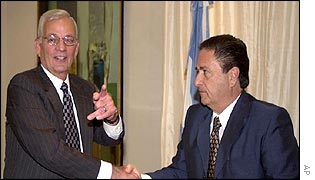 Paul O'Neill met President Duhalde in Buenos Aires
Argentina's continuing political and economic crisis could soon get worse, according to a leading academic who follows the country's fortunes. Professor Martin Uribe of Pennsylvania University said the current policies emanating from the International Monetary Fund (IMF) and the US government were "counter-productive". "I think that at this point the first priority is to remove the existing financial restrictions that are in place in Argentina," he said. "I don't see neither the IMF nor the US administration placing the removal of those restrictions at the top of the list, so until that is done I don't see Argentina moving on." The country has placed restrictions on people withdrawing savings from their bank accounts. Flares and fireworks The past week has been another difficult one for the South American nation.
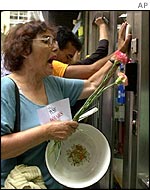
Its government was reduced to pleading for international aid in the latest attempt to overcome the financial crisis. President Eduardo Duhalde met US treasury secretary Paul O'Neill in the capital Buenos Aires. But while the president was pressing his case for urgent financial support, the public welcome for Mr O'Neill - one of the few people most likely to be able to help Argentina - could not have been worse. He faced noisy protestors who lit flares and fireworks outside his hotel. They even burnt the American flag along with photos of Mr O'Neill during a night-long vigil. Placards urged the Americans and the International Monetary Fund to leave Argentina alone. Hard to understand perhaps, given that no-one else is likely to want or is even able to offer substantial aid at this time. Twenty currencies Argentina descended into economic and political crisis last December following an IMF decision to suspend $22bn worth of aid.
The then government stood accused of failing to control spending. It has meant hardship for millions of Argentines. They have seen their bank accounts frozen to prevent a further run on already depleted currency reserves. And they have had to contend with up to 20 alternative currencies introduced by regional governments to replace the almost worthless peso. Beef steaks Mr O'Neill left Buenos Aires only offering "technical advice" and gave no further details of any aid package.
The US and IMF stance toward Argentina appears in marked contrast to its position on other South American nations. Neighbouring Uruguay has been having problems of its own, but the US quickly ran to its aid in the past week with an emergency bridging loan. The IMF has also just given Brazil its biggest ever loan of $30bn. Strategic interest David Lubin of HSBC said the US standpoint is not too difficult to understand. "The United States is the hegemony, and the hegemony chooses not to apply universal rules that govern its behaviour but wants to adopt a case-by-case approach depending on its individual strategic interests, depending on the country," he said. Mr Lubin maintained that the US also tends to act where it has a strong strategic interest. One example is in Turkey which was also given a big bail-out last year. "In the case of Brazil it seems that the United States has sort of belatedly come to realise that perhaps the US financial sector and the US corporate sector might face a degree of pressure from a collapse in Brazil," Mr Lubin said. "That would be ill-timed given other things that are going on in the United States corporate sector and the collapse in US asset prices." Operating without banks Key to the IMF's plan for Argentina are stricter controls on public spending. But that, of course, brings with it the inevitable pain of unemployment and fewer public services. Professor Uribe says no-one can expect a country such as Argentina in its current condition to balance its budget. "To achieve a balanced budget I think that a prerequisite is that some output is generated," he said. "We should remind ourselves that Argentina has been operating virtually without banks since the beginning of this year." "On those conditions without savings, without lending to firms, output is not generated - as a result the government cannot collect taxes so it is not reasonable to expect balanced budgets before requiring the removal of the banking restrictions." "Having no banks operating is worse than having all banks bankrupt or at least the equivalent, so nothing can be worse than the status quo." | |
See also:  07 Aug 02 | Business 08 Aug 02 | Business 30 Jul 02 | Business 24 Jul 02 | Business 16 Jul 02 | Business 07 Jul 02 | Business Internet links: The BBC is not responsible for the content of external internet sites Top Business stories now: Links to more Business stories are at the foot of the page. | |||||||||||||||||||||||||||||||||||||||||||||||||||||||||||||||||||||||||||||||||||||||||||||||||||||||||||||||||||||||||||||||||||||||||||||||||||||||||||||||||||||||||||||||||||||||||||||||||||||||||||||||||||||
| |
|  E-mail this story to a friend E-mail this story to a friend |
| |
| Links to more Business stories |
| | | ||
 | ||||
 | | Back to top
| ||
| ---------------------------------------------------------------------------------- To BBC Sport>> | To BBC Weather>> | To BBC World Service>> ---------------------------------------------------------------------------------- © MMIII | News Sources | Privacy |