|
 |
 | | | | | | |||||||||||||||||||||||||||||||||||||||||||||||||||||||||||||||||||||||||||||||||||||||||||||||||||||||||||||||||||||||||||||||||||||||||||||
| | | You are in: Business | |||||||||||||||||||||||||||||||||||||||||||||||||||||||||||||||||||||||||||||||||||||||||||||||||||||||||||||||||||||||||||||||||||||||||||||||
|
| | Friday, 26 July, 2002, 07:15 GMT 08:15 UK Secrets of the stock market soothsayer 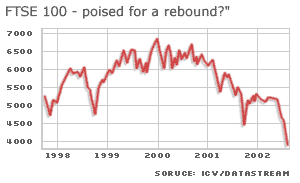
In all the best blockbusters, when disaster has dawned and nemesis looks likely by breakfast, there appears in the script a snowy-haired elder. The role of this craggy mystic is, beyond providing a part for a credibility-boosting Hollywood legend, to show our harried heroes how knowledge can be a match for brute strength. To seek some lessons from history, perhaps. And in the disaster movie that is the share meltdown, playing at stock markets throughout the world, it is a role played by David Schwartz, the (albeit dark-haired) Sage of Stroud. Hideaway in the hills Where did the media head as the dot.com bubble burst? Or as shares plunged after 11 September?
Or fell further during the last weeks as WorldCom-gate scrambled our nest-eggs? To the (Cotswold) hills and Mr Schwartz, purveyor of wisdom amid market mayhem. "I get a lot of calls when something powerful or unexpected happens," he says. "It is when people want a perspective, some context." Key predictions It was Mr Schwartz who told us that shares would fall by about 15% after the 11 September strikes, and then recover. They did. It was Mr Schwartz who in December 2000 warned that the Nasdaq, which had already tumbled 20% to 4,000 points, would fall below 1,500. It has. It was Mr Schwartz who told us in late 1997 that share gloom approacheth. The FTSE 100 shares index rose by about a quarter in the next six months. Ah well. "I am never 100% right - nobody can be." Mr Schwartz says. "All I am saying that this and that has happened in the past, and trying to give some context to a present or future event." "All I am doing is quoting historical odds." Nerve centre Not that he is a historian. He may be quoted in newspapers as a stock market historian, and his e-mail address may even be based around the term.
But Mr Schwartz is, he says, "a statistician, a record keeper". A juggler, even, of share price, inflation, interest rate data, which is spun around light-laden cyberbanks before emerging redigested on a tear-off sheet. Or something like that. Mr Schwartz in fact employs computer equipment in production when share prices were, um, around where they are today. "The real issue in my analysis is not the power of the PC," he says. The key lies in knowing what statistics to compare, and how. "What you are reading when you read one of my columns is 30 or 40 years of knowledge in how to manipulate data." Early days Indeed, Mr Schwartz started off his career as a market researcher in New York. He was born in the Bronx when it was a "nice middle class neighbourhood". His father was a firefighter, his neighbours the likes of policemen and postal workers. But he read statistics at university and, after national service, plumped for market research because, he claims, he "opened the jobs pages at m". He founded market research firm Consumer Response Corporation, worked for the likes of Saatchi & Saatchi, Kelloggs and former US president Ronald Reagan on an election campaign, before selling up in 1986. Transferable skills It was then, pay-off in hand and having moved to Britain with his British wife, that he turned in earnest to stock market analysis.
"I wanted to manage my assets in a better way than the traditional way of buying at the top and selling at the top. "So I got historical data and started to analyse it in precisely the same way I had analysed public opinion polls when doing market research. The only difference was the variables used, Mr Schwartz says. "Instead of trying to find out who was voting for who, I was looking at whether stock markets rose in December, their relation to inflation, or whether retail sales were rising at the time." Weird science He discovered that there was a 77% probability of stock markets rising on 6 June in any year, but just a 28% chance of gains on 26 September. He found that airline shares typically declined in August. And he deduced that summer was the worst seasons for stock investors - in both hemispheres. "In the US and Europe, the weakest point is May, June, July. In Australia and South Africa it is December and January. "Why it is - temperature, day length - I don't know. But there is an incredible correlation." Conflict factor His predictions over the markets' response to the 11 September attacks followed analysis of the reaction to shocks such as Pearl Harbor and the outbreak of the Korean War.
"I found that prices fell something like 14% in the days that followed, and then a bull market followed. "There was a common element - every time America finds itself at war, or in a military emergency, prices fall, then a rally starts." Gloomy outlook But any investor thinking that the cloud of a US war on Iraq might at least bear a silver stock market lining should consider that other forces are at work. The markets are, currently, suffering the hangover of the kind of run which represents, in Mr Schwartz's words, a "once in two centuries event". "The market went up so sharp that on a price graph even the 1987 crash looked like a blip. "History teaches us that when markets outperform by a drastic amount over any 15-year period, they lose money in the next 15. "There has never been an exception, in any index, in any country, nor in any century. "Fifteen years from now, [share] prices will be lower than they are now, factoring in the effects of inflation." And the sectors worst affected by the bubble will be the slowest to recover. "The Nasdaq is not going anywhere for a long, long time." Rebound prospects Not that Mr Schwartz eschews careful stock buying following the current share falls.
By historical standards, the current plunges, on the FTSE at least, are sufficient to indicate a bounce to come. But gone are the days when cash could be made simply by holding onto individual stocks for years, and letting the rising market do the rest. "'Buy and hold' is a corrupt, discredited strategy. I can tell you this from all my analysis." Better to buy shares when they have "taken a punch on the nose" and sell once gains of perhaps 20% are seen. "The only way to make money in the years ahead is 'in and out'. Buy and sell." City lay-offs Such an investment atmosphere will foster changes in the City, where banks, suffering lower revenues, will be quicker to cut posts "especially big jobs".
"All these investment banking chaps in red braces earning �300,000 a year. I hope they are saving some money, because a lot of their jobs will be gone." And, with indexes struggling, the era of the tracker fund has ended, to be replaced by a new emphasis on stock picking and active management of shares. "The index investor may perform in step with the market, but the market is not going anywhere for the next decade, if I have got it right." 'Proof of the pudding' And has Mr Schwartz got it right? Investors dashing to cash in their tracker funds should be aware that Mr Schwartz himself only places modest faith in his predictions. Most of his cash is tied up in gilts and guaranteed interest accounts, leaving only some free for share investment. He also spread bets, and the likes of IG Index willingly accept his punts. It is also telling that, almost like a nervous tick, he follows each prediction with the phrase: "If history is a guide." "I have to say that. That's my hedge. I don't know what will happen in the future." But is history a guide? "I think it is. The proof of the pudding is going to be in this downturn. "Most downturns end when shares approach a downturn of 37%, and this one has [for the FTSE] gone down well over 40%. I think we are at the bottom. "Is the past any guide? We will see very soon." | |
See also:  26 Jul 02 | Business 12 Mar 02 | Business 11 Mar 02 | Business 10 May 01 | Business Internet links: The BBC is not responsible for the content of external internet sites Top Business stories now: Links to more Business stories are at the foot of the page. | |||||||||||||||||||||||||||||||||||||||||||||||||||||||||||||||||||||||||||||||||||||||||||||||||||||||||||||||||||||||||||||||||||||||||||||
| |
|  E-mail this story to a friend E-mail this story to a friend |
| |
| Links to more Business stories |
| | | ||
 | ||||
 | | Back to top
| ||
| ---------------------------------------------------------------------------------- To BBC Sport>> | To BBC Weather>> | To BBC World Service>> ---------------------------------------------------------------------------------- © MMIII | News Sources | Privacy  |