
|
 |
 | | | | | ||||||||||||||||||||||||||||||||||||
| | You are in: Business | ||||||||||||||||||||||||||||||||||||||
 | | Friday, 19 April, 2002, 16:42 GMT 17:42 UK German wage talks collapse 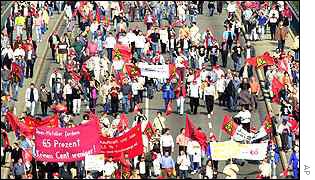 Strike action could damage the German economy Germany's engineering sector could be hit by strike action after pay talks between unions and employers broke down. The engineering union IG Metall is now set to ballot its members from Thursday next week on industrial action. A strike could cause widespread disruption in Germany, damaging the economy just as it has begun to show signs of recovery. Industrial action could also be embarrassing for the government, with elections taking place later this year. Deadlock Leaders from the engineering union IG Metall and employers federation Gesamtmetall met on Friday morning in a last-ditch attempt to reach a deal.
IG Metall's head Klaus Zwickel said employers had "thrown away the last chance of solving the wage conflict peacefully". The talks covered 820,000 workers in one region of Germany, but the deal had been expected to set the pattern for settlements across the country. IG Metall had originally asked for a 6.5% pay rise, while employers were offering only 2%. The union is reported to have cut its demand to about 4%, but employers refused to raise their offer above 3.3% over 15 months. Martin Kannegiesser said the offer represented the "threshold of pain for our companies". "It's probably now going to come to industrial action. We just have to see it through," he said. Damage In recent weeks, IG Metall has been stepping up the pressure on employers by staging a number of brief stoppages. But a full strike affecting key engineering sectors such as the car industry could be much more damaging for the economy, and a political embarrassment for the government. Chancellor Gerhard Schroeder faces a general election in September, and has already been forced to admit that he will not meet a promise to reduce unemployment to 3.5 million before the poll. The number of jobless in Germany is currently hovering around the 4 million mark. | |
See also:  Internet links: The BBC is not responsible for the content of external internet sites Top Business stories now:  Links to more Business stories are at the foot of the page. | ||||||||||||||||||||||||||||||||||||
|
Links to more Business stories |
 | | ^^ Back to top News Front Page | World | UK | UK Politics | Business | Sci/Tech | Health | Education | Entertainment | Talking Point | In Depth | AudioVideo ---------------------------------------------------------------------------------- To BBC Sport>> | To BBC Weather>> ---------------------------------------------------------------------------------- © MMIII|News Sources|Privacy  |


 E-mail this story to a friend