
|
 |
 | | | | | ||||||||||||||||||||||||||||||||||||
| | You are in: Business | ||||||||||||||||||||||||||||||||||||||
 | | Tuesday, 5 March, 2002, 15:28 GMT Opec talks push oil to five-month high 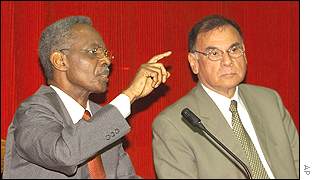 Opec waits for Russia's decision in April Organisation of Petroleum Exporting Countries (Opec) expectations that Russia, the world's second-biggest oil exporter, will continue to restrict its oil exports has lifted prices to a five month high. "I'm personally convinced that Russia will support a further restriction on its exports," Opec general secretary Ali Rodriguez said in Moscow after talks will Russian officials.
Russia reluctantly agreed in December to cut its oil exports by 150,000 barrels per day for the first quarter of this year, which together with Opec cuts of 1.5 million barrels per day, pushed the oil price above $20 per barrel. Common interest "Russia has so far helped us to avoid the collapse of world oil prices," said Opec President Rilwanu Lukman, who is accompanying Mr Rodriguez. "Despite the fact that we are competitors there is no need to view our relations as adversary." Opec will meet in Vienna on March 15 and is expected to leave production at current levels while Russia said it would decide on output before 1 April. A barrel of Brent North Sea crude fell back to $21.66 after hitting $21.89, its highest closing value for almost two months, in the run-up to Mr Rodriguez's mission to Moscow. "The market is tightening, and Opec really doesn't need to go on like this," Dr Leo Drollas at the Centre for Global Energy Studies told the BBC's World Business Report. Enforcing quotas Most other non-Opec countries which agreed to restrict exports for the first quarter of this year - such as Norway and Angola - have already agreed to a three month extension. "It's in our common interest. The current price is a common problem, it affects all producing countries so we have to assume a common position," Mr Rodriguez said. Russia's indecision is the one variable which could scuttle Opec's price-fixing plans. The government relies heavily on revenues from oil exports, and higher production and strong prices have boosted the country's economic growth since 2000. But the Russian oil companies oppose the restrictions because it limits their revenues and expansion plans. The cap on first-quarter's output was largely seen as painless, as oil production and exports usually fall in the winter months because off-shore oil fields become ice bound preventing exports. | |
See also:  Internet links: The BBC is not responsible for the content of external internet sites Top Business stories now:  Links to more Business stories are at the foot of the page. | ||||||||||||||||||||||||||||||||||||
|
Links to more Business stories |
 | | ^^ Back to top News Front Page | World | UK | UK Politics | Business | Sci/Tech | Health | Education | Entertainment | Talking Point | In Depth | AudioVideo ---------------------------------------------------------------------------------- To BBC Sport>> | To BBC Weather>> ---------------------------------------------------------------------------------- © MMIII|News Sources|Privacy  |


 E-mail this story to a friend