
|
 |
 | | | | | ||||||||||||||||||||||||||||||||||||||
| | You are in: Business | ||||||||||||||||||||||||||||||||||||||||
 | | Friday, 1 March, 2002, 15:38 GMT Harsh words for India's budget 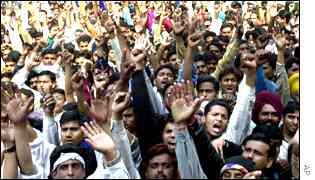 Protestors disapprove of Sinha's budget India's newspapers have said the 2002/03 federal budget unveiled on Thursday will not be enough to revive the declining economy, but the country's stock market has bounced back. "It is a budget that hurts everybody, unless of course you are a non-resident or a foreign company," said the Times of India.
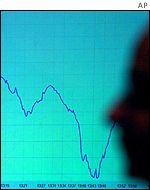
"There is a great deal on offer in the sector-specific initiatives, but to the key question of what the budget does for speeding up economic growth, the answer that suggests itself is: Not enough." A more optimistic mood reigned on the stock market as dealers focused on the specific benefits for corporations. Indian shares rose sharply , recouping most of the previous day's losses. The benchmark Bombay Sensex index rebounded to close 3.3% higher after sliding 3.87% on Thursday as tax proposals in the budget dismayed investors. Markets lukewarm But after digesting the details, analysts still felt the budget offered too little for industry. "It was a mixture of good and bad, and there could have been some signal or message to excite industrial groups to invest, to spur them into action," Rajiv Saxena, Managing Director of Lazard India told the BBC's World Business Report.
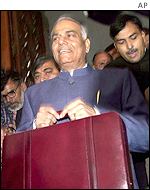
Mr Sinha defended himself, saying the country's fiscal deficit had reached an "unsustainable" level, and that his latest budget tried to strike an appropriate balance. Analysts' have also expressed concerns that the government's projections for tax revenue and economic growth are too high, and the forecast deficit too low. The deficit - which the government has identified as the key factor hampering economic growth - is expected to widen to 5.7% of gross domestic product in the coming year. Sinha criticised Virtually all Indian newspapers stressed that most Indians will be paying more tax during the year beginning 1 April. "All taxpayers, individuals and corporates, will be left with less to spend or save," said the Times of India.
The Business Standard added the government had made a brave but ultimately futile attempt to rein in the budget deficit. "It's a brave budget... Try and recall the last time a finance minister raised the prices of fertiliser, kerosene or cooking gas. And dropped the interest rates on small savings. And took away tax incentives on those savings. And taxed dividends, and imposed a tax surcharge." | |
See also:  Internet links: The BBC is not responsible for the content of external internet sites Top Business stories now:  Links to more Business stories are at the foot of the page. | ||||||||||||||||||||||||||||||||||||||
|
Links to more Business stories |
 | | ^^ Back to top News Front Page | World | UK | UK Politics | Business | Sci/Tech | Health | Education | Entertainment | Talking Point | In Depth | AudioVideo ---------------------------------------------------------------------------------- To BBC Sport>> | To BBC Weather>> ---------------------------------------------------------------------------------- © MMIII|News Sources|Privacy  |



 E-mail this story to a friend