
|
 |
 | | | | | |||||||||||||||||||||||||||||||||
| | You are in: Business | |||||||||||||||||||||||||||||||||||
 | | Thursday, 21 February, 2002, 14:52 GMT Analysis: Turkey's year of crisis  Is this another false dawn for Turkey?
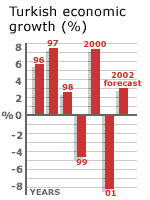
"The patient jumps around a bit, but at the end of the day, he's still dead." Exactly a year ago, in the teeth of its worst financial crisis since World War II, Turkey devalued its currency, the lira. Since then, the Turkish economy has leapt about a fair bit, and in recent months has even shown encouraging signs of life. But is this a real revival - or just another painful spasm? Green shoots Devaluations usually give an economy a shot in the arm, because they make exports cheaper, reduce the burden of domestic debt, and encourage foreign firms to invest. Turkey suffered a tumultuous few months after its February 2001 devaluation, but now seems to be reaping a few of those benefits. 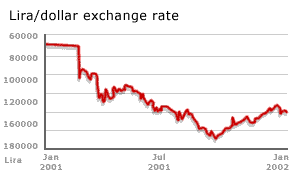 The stock market has risen 20% since the middle of last year - at a time when the rest of the world's bourses have plunged. After shrinking by a catastrophic 8% last year, Turkish economic output is predicted to grow by 3% this year, and inflation should be a moderate - by Turkish standards - 35%. On Wednesday, the mood of modest cheer persuaded the Turkish Central Bank to cut its main interest rate by two full percentage points - although it is still an eye-popping 57%. And in a sign that foreign firms are interested in devaluation bargains, Cadbury Schweppes on Thursday announced it was paying �67m for Kent, Turkey's biggest confectionery firm. American friends These green shoots have a lot to do with last year's devaluation. But they have just as much to do with post-11 September geopolitics.
On 4 February, Turkey won a $16bn stand-by credit from the International Monetary Fund (IMF) - thereby incidentally becoming the Fund's biggest borrower. Given the truculent attitude of the IMF before 11 September, many see the hand of Washington behind the new loan. "Turkey would probably have got that cash anyway," says Merli Baroudi, deputy director of country analysis at the Economist Intelligence Unit. "But without 11 September, it may not have been as quick, and it may not have been as much money." Miles to go So with American patronage and the devaluation dividend, is Turkey out of the woods? Probably not: the immediate future is still fraught with risks.
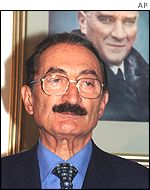
Prime Minister Bulent Ecevit is respected and a canny operator, but at 76 years old, he is notoriously frail - even at times absent-minded. Even after various bouts of blood-letting last year, the coalition parties still have so little in common that it is hard to imagine them surviving long in Mr Ecevit's absence. If the government fell, polls indicate that none of the three parties would be able to command even the 5% support necessary to get into parliament, let alone to form another government. Nasty neighbours This threat could be enough to hold the coalition together. But that is to overlook the second main risk factor: the possibility of a US military campaign against Iraq, one of Turkey's eastern neighbours.
A heavy influx of refugees would weigh heavily on the public purse, already considerably overstretched after bearing the cost of last year's economic reforms. Balancing act Third, potential horrors lurk in the banking sector, run ragged by decades of reckless lending and insufficient supervision. Last year, the Turkish government did sterling work cleaning up the balance sheets of state-run banks - the costs of which forced the government to go cap in hand to the IMF. But the state sector accounts for only around one-fifth of the total Turkish banking industry, and no one knows quite how bad the private sector could prove to be. On Wednesday, the government finally got around to publishing a tentative timetable for boosting capital in the banking sector. Bank owners are to consult with the authorities now over how they plan to increase capital, something that should be complete by the end of June. Banks that cannot reach target levels can then apply for state support, a process that is already being estimated to cost $4bn. Lira losers Everyday life and business, meanwhile, have barely improved.
Those lucky enough to be still in work have seen the dollar value of their savings and incomes halve, while their financial obligations - usually set in hard currency - ballooned. And while the government has made helpful noises about loosening up the notoriously bureaucratic business climate, investors complain that almost nothing has been done. The big business story in the past few weeks has been a bizarre and bitter row between Uzan family, which owns number two Turkish mobile phone firm Telsim, and cellular giants Nokia and Motorola. The multinationals, which are suing Telsim for fraud, say the Uzan family misused some $2.7bn of their money. Selling a couple of chocolate factories to Cadbury can't quite take away the bitter taste. | | See also:  Internet links: The BBC is not responsible for the content of external internet sites Top Business stories now:  Links to more Business stories are at the foot of the page. | |||||||||||||||||||||||||||||||||
|
Links to more Business stories |
 | | ^^ Back to top News Front Page | World | UK | UK Politics | Business | Sci/Tech | Health | Education | Entertainment | Talking Point | In Depth | AudioVideo ---------------------------------------------------------------------------------- To BBC Sport>> | To BBC Weather>> ---------------------------------------------------------------------------------- © MMIII|News Sources|Privacy  |



 E-mail this story to a friend