
|
 |
 | | | | | |||||||||||||||||||||
| | You are in: Business | |||||||||||||||||||||||
 | | Thursday, 14 February, 2002, 10:27 GMT New flood tax mooted 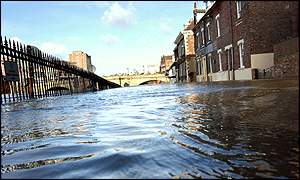 Flooding has once again caused misery across the UK Householders living in flood plains could end up paying a special tax to contribute towards the defence of their properties, under new proposals being considered by the government. The news comes as many people in the UK continue the clear-up following the floods of the past week. The insurance industry has been urging the government to improve flood defences across the country. Concern has been growing that repeated flooding in some parts of the UK could leave many houses uninsurable. Several options The floods minister Elliott Morley outlined a number of options under consideration by the government on Wednesday. One proposal would see the bulk of money for flood defence continuing to come from central government, but "top up" cash now contributed by all council tax payers would be replaced by a levy on people whose homes are at risk.
But Mr Morley warned that house buyers had to check flooding risks when buying a property, especially houses near river banks. "In those circumstances it really is an issue of buyer beware, because people who buy these properties know very well that they are at risk of frequent flooding," he said. He noted these were the properties where there were problems with insurance, but said he was "much more worried about the vast majority of people who want to have insurance and to make sure that facility continues to be available." More action urged At the moment all ABI members are signed up to an agreement under which firms have promised to continue to insure existing customers in all but exceptional circumstances. These circumstances include situations where flooding is so common, it has become a habitual risk for the property. The ABI agreement runs out at the end of this year and the insurance industry wants the government to introduce more anti-flood measures. "This is another consultation report, and we welcome aspects of it," said Mary Francis, director general of the Association of British Insurers (ABI) in response to the government's latest move. "But we urgently need Government action and firm decisions which will improve flood defences and flood management strategy in the UK." The ABI says it is too early to say how much damage the recent flooding has caused. But the damage this time around is not expected to anywhere near as much as that seen during the extensive flooding of Autumn 2000. The cost of those floods reached �1.3bn, of which �850m stemmed from claims on damage to domestic properties. Storm damage The ABI has said the damage caused by last month's storms could lead to claims totalling �75m. Severe gales across northern England, Scotland and Northern Ireland during January killed seven people and caused widespread damage to property. A spokesperson for the ABI said that while the figure was "incredibly difficult to estimate" the total could rise even further as more people send in their insurance claims. The estimate does not include the value of claims expected to arise from the recent floods. | | See also:  Internet links: The BBC is not responsible for the content of external internet sites Top Business stories now:  Links to more Business stories are at the foot of the page. | |||||||||||||||||||||
|
Links to more Business stories |
 | | ^^ Back to top News Front Page | World | UK | UK Politics | Business | Sci/Tech | Health | Education | Entertainment | Talking Point | In Depth | AudioVideo ---------------------------------------------------------------------------------- To BBC Sport>> | To BBC Weather>> ---------------------------------------------------------------------------------- © MMIII|News Sources|Privacy  |


 E-mail this story to a friend