
|
 |
 | | | | | ||||||||||||||||||||||||||||||||||||||||||
| | You are in: Business | ||||||||||||||||||||||||||||||||||||||||||||
 | | Thursday, 14 February, 2002, 09:20 GMT Venezuela's currency in freefall 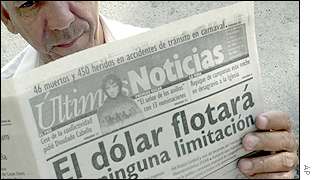 News that the bolivar would float spread quickly Venezuela's currency has plummeted 25% against the US dollar after the government scrapped five-year-old exchange rate controls.
The bolivar weakened to as low as 1,001 to the dollar on Wednesday before closing at 981 compared with 795 on Friday, the Central Bank of Venezuela reported. The mood on the street was angry and frustrated, with Venezuelans warning of dire consequences to come, after weeks of strikes. "This is actually a devaluation and Venezuelans now should get used to higher prices," said Janet Kelly, professor of public policy at the Caracas Graduate Institute of Advanced Management. Financial markets pleased The currency has been under increasing pressure as the international financial markets showed their disapproval of recent government policies. "My first impression is that the economic measures are very positive, including allowing the [currency] to float," Graciana del Castillo, Standard & Poor's lead Venezuela analyst, said.
"But there is still the political concern." The International Monetary Fund welcomed Venezuela's decision to float its currency. "We have taken note of the flotation of the bolivar... We believe the measures go in the right direction but we do need to evaluate them as more details become available," said the IMF's external relations director Tom Dawson. The foreign reserves of Latin America's fourth largest economy have dropped by $6bn (�4.2bn) since November to $13bn, largely as a result of propping up the currency. The director of the Venezuelan Central Bank has said the bank would not spend any more of its foreign reserves to shore up the bolivar. "The central bank is not going to risk any more of its foreign reserves to feed capital flight," Central Bank director Domingo Maza told local television. Venezuela's stock market closed 10% higher as investors sought a haven for their investments aside from US currency. Outlook worsens The capital flight has been partly driven by Venezuela's volatile political situation, and also demands from business groups for a devaluation to boost domestic and foreign demand for Venezuelan goods. The floatation is expected to stoke inflation to levels that Venezuelans, 80% of whom live in poverty, can ill afford.
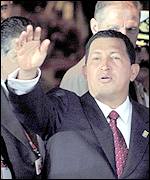
The economy has been deteriorating, as falling international oil prices slowed down an economic boom, and there have been large-scale anti-Chavez strikes. Oil is Venezuela's main export. It is the biggest supplier of oil to the US. Chavez moves President Hugo Chavez said the move was necessary to "improve the competitiveness" of Venezuela's exports which had been "buffeted by low oil prices". On Tuesday, Mr Chavez also announced budget cuts of 7% to tackle the deficit, which is expected to hit $8bn this year. Venezuela is the second Latin American country to permit its currency to float against the US dollar within a week. On Monday, Argentina finally floated the peso after it scrapped its 10-year-old peg to the US dollar and defaulted on $141bn of debts at the start of the year. | |
See also:  Internet links: The BBC is not responsible for the content of external internet sites Top Business stories now:  Links to more Business stories are at the foot of the page. | ||||||||||||||||||||||||||||||||||||||||||
|
Links to more Business stories |
 | | ^^ Back to top News Front Page | World | UK | UK Politics | Business | Sci/Tech | Health | Education | Entertainment | Talking Point | In Depth | AudioVideo ---------------------------------------------------------------------------------- To BBC Sport>> | To BBC Weather>> ---------------------------------------------------------------------------------- © MMIII|News Sources|Privacy  |



 E-mail this story to a friend