In a series of special reports for BBC World Service, Global Business reports on a second industrial revolution and the upheavals which are changing not only China but the whole world. China is taking the lead in developing ways of sending data through phones |
A growing number of Chinese migrants, who have become successful in the hi-tech world of places like Silicon Valley in the US, are returning home to take advantage of China's booming technology market. With an estimated 100 million PC users in the country, e-commerce is thriving in China, with internet service providers (ISPs) especially flourishing.
And where Chinese companies are hoping to lead the world is in combining this with the world's biggest mobile phone market - and selling the resultant technology to the globe.
"In certain areas, we are actually pushing the envelope of technology," Ye Xin, who headed back to China to start a number of successful companies after 15 years in Silicon Valley, told BBC World Service's Global Business programme.
"Looking at the stuff we're doing here, we're developing a lot of the service ourselves.
"Some of the solutions are not even thought about outside of China - that's why you see leading technology companies like Oracle and BA and others thinking about setting up R&D centres in China," he said.
Balancing act
The marriage of e-commerce with mobile phones is known as mobile computing - the ability to access the internet and other multi-media, such as video and audio, on handsets.
In total, there are over 300 million mobile phones in China, and the number is growing by the minute.
The faces of hi-tech China 
|
And the subscriber base has continued to grow very fast - from two million people in 1994 to 200 million in 2004. But the sector that has seen particular growth is value-added data services, such as internet portals and audio players. One Chinese company that provides these has now been listed on the Nasdaq hi-tech stock exchange.
And in another high-profile deal, Disney have signed an agreement with Chinese ISP sohu.com to allow the use of their images on MMS (multimedia messaging service) messages.
Sohu are a highly profitable ISP, with money coming in from both advertising and sponsored search.
But more importantly, the company is focusing on wireless services, such as access to the news through mobile phones as they key to sustained future profits.
Caroline Straathof, the head of Sohu's news service, said that the distinction between what is available on a PC and what is available on a mobile phone will blur very soon.
"The two are more and more going to morph in coming years," she added.
"I think five years from now, I won't be making that distinction anymore."
Sohu's news service has around 150 of the company's 1,000 employees, although the site does not write its own content, but collates stories from other sources.
"Websites started with 'who had the story first'," Ms Strathoff explained.
"But we realised with modern technology, that hardly makes a difference anymore. So the differentiation nowadays come from the editorial stands you take.
"It is a bit of a give and take towards the Chinese government in that regard. But as a commercial organisation, we have to find new areas, and make content attractive for our readers."
This approach, the company insists, has allowed them to specialise in quickly providing news to multimedia platforms, without the problem of writing it themselves.
However, exactly what content to supply on these platforms is a difficult balancing act for many companies, not only Sohu.
 China's government has tight control over the media industry |
While the Chinese state has permitted private magazines and TV companies, the mainstream media remain firmly in government hands, and the internet is monitored and blocked by censors. Sohu's chief executive Charles Zhang told Global Business that news was important to the company, but that deciding which news to broadcast created a tension between independence and what was "appropriate" for Chinese people to know.
"On one hand, there is a long-term goal of providing independent opinions and news," he stressed.
"On the other hand, the news organiser has to be a good corporate citizen, to understand where China is going and at what stage - so reporting in a way that society can tolerate, and not causing the traumatic effect to society.
"We, as a portal company and news organisation, understand the massive transformation, and also the important task that the government is doing in transforming China into a modern society."
You can hear Global Business on BBC World Service every Saturday at 18:32 GMT in Europe.


 One-Minute World News
  News services
 E-mail this to a friend
  Printable version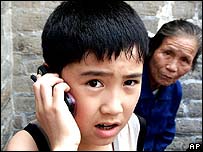
 In pictures


 Listen again to Global Business


