|
 |
 | | | | | | ||||||||||||||||||||||||||||||||||||||||||||||||||||||||||||||||||||||||||||||||||||||||||||||||||||||||||||||||||||||||||||||||||||||||||||||||||||||||||||||||||||||||||||
| | | You are in: Asia-Pacific | ||||||||||||||||||||||||||||||||||||||||||||||||||||||||||||||||||||||||||||||||||||||||||||||||||||||||||||||||||||||||||||||||||||||||||||||||||||||||||||||||||||||||||||||
|
| | Thursday, 11 July, 2002, 17:10 GMT 18:10 UK China's army charm offensive China's army started as communist guerrillas
Senior Colonel Hu Dongmin says he doesn't think China is a threat. "Chinese people and soldiers are peace-loving," he says. "And besides, we're not modernised enough to constitute a threat to any other country." Senior Colonel Hu was the opening act of a charm offensive put on this week by the People's Liberation Army (PLA).
The PLA issued a rare invitation to a group of foreign journalists to visit an army and air force base just outside of Beijing. The visitors were welcomed by a military band, followed by a guard of honour from the PLA's 196th Brigade. During lunch at the mess, journalists were even permitted to chat with new recruits about life in the army. "When you're young it's your duty to protect your country," said one 18-year-old who would only identify himself by his family name, Zhao. Zhao, a railway workers' son from eastern Shandong province, earns $10 a month serving his country.
"I'd like to stay here if I have the opportunity," he said. "It's better than home". But Senior Colonel Hu and his men will not convince everyone that China poses no military threat. This year, the nation's acknowledged defence budget is $20bn. But some outside analysts put that closer to $50bn, and reckon China to be the biggest importer of arms in the world. 'Playing catch-up' China watchers are in little doubt about why the developing nation spends so much of its money on the military: the island of Taiwan, which China still regards as a renegade province. "The PLA is playing catch-up ball," says former Clinton adviser Professor Kenneth Lieberthal. "They recognise that there is a possibility - slim, but not negligible - that they will face the US military forces across the Taiwan Straits at some point". Recent purchases include 72 Su-27 fighter-ground-attack aircraft, 100 S-300 surface-to-air missiles, and four Kilo-class submarines, all from Russia. Other suppliers include South Africa, Israel and even Rolls Royce. The British engine maker recently sold 90 jet engines to China.
The PLA has come a long way from its days 70 years ago as a communist guerrilla operation. That may have been enough to conquer China in 1949, but these days the nation's leaders think they need something more sophisticated. "Taking a peasant and giving them a gun is no longer adequate to the kind of task they face," says Professor Lieberthal. There are other changes afoot, too. New recruits Senior Colonel Hu was keen to reassure the visiting journalists that his soldiers are fed properly, with rations 20% bigger than a year ago. The increase is part of a PLA drive to boost morale and attract better quality recruits. There are still an unwieldy 2.5 million soldiers in the PLA, but its leaders want to form elite groups to close the gap in skills and technology. But with poor pay and conditions - a colonel earns around $350 a month - the military isn't an attractive employer for educated young Chinese.
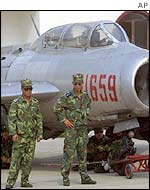
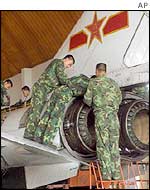
The visit to the 196th Brigade suggested that Chinese soldiers lag behind many foreign counterparts. At the brigade's training centre, Lieutenant Zhang, a high school graduate, is studying computers. Asked what computers can be used for, Lieutenant Zhang was vague. "Lots of things", he said. Asked to be more specific, he answered: "typing reports and typing schedules". Next door at the 24th Air Division there are similar problems. Old technology The division's pilots proudly put on an air show for the invited journalists. But the Chinese-built F-8s they fly use decades-old technology. The air force does have more sophisticated, imported aircraft - the Su-27s, for instance - but military analysts estimate that 60% of those are grounded because the PLA lacks the skill to fly and maintain them. One thing the military does work very hard at is politics. Up to 30% of training is taken up with political classes. The army is a potent political force in China. The nation's leaders need to know that in times of crisis it can be relied upon. In 1989 the army was called upon to crush protestors in Tiananmen Square. More recently, state media has celebrated PLA soldiers as heroes for their annual flood-fighting efforts. New leaders This year, in particular, the PLA's political role is crucial, as China's leaders prepare to hand over the reins to a new generation of leaders. Hu Jintao looks set to take on the mantles of state president and general secretary of the Chinese Communist Party. It is unclear whether he will also take over the role of chairman of the Central Military Commission from current leader Jiang Zemin. Either way, support from the army is vital. Asked his opinion about the leadership change, Senior Colonel Hu laughed and issued a swift "no comment". "Our army has a duty to defend our country," he added later on. "That's the purpose of our training. We always follow orders from the central government". | | See also:  11 Jul 02 | Asia-Pacific 06 Mar 01 | Asia-Pacific 26 Jan 00 | Asia-Pacific 08 Mar 02 | Country profiles Internet links: The BBC is not responsible for the content of external internet sites Top Asia-Pacific stories now: Links to more Asia-Pacific stories are at the foot of the page. | ||||||||||||||||||||||||||||||||||||||||||||||||||||||||||||||||||||||||||||||||||||||||||||||||||||||||||||||||||||||||||||||||||||||||||||||||||||||||||||||||||||||||||||
| |
|  E-mail this story to a friend E-mail this story to a friend |
| |
| Links to more Asia-Pacific stories |
| | | ||
 | ||||
 | | Back to top
| ||
| ---------------------------------------------------------------------------------- To BBC Sport>> | To BBC Weather>> | To BBC World Service>> ---------------------------------------------------------------------------------- © MMIII | News Sources | Privacy |