
|
 |
 | | | | | ||||||||||||||||||||||||||
| | You are in: World: Asia-Pacific | ||||||||||||||||||||||||||||
 | | Thursday, 4 April, 2002, 15:13 GMT 16:13 UK Malaysia's labour dilemma 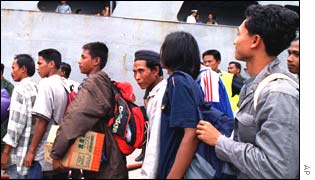 The door has already been shut on Indonesian arrivals
The amnesty period will continue until tough new amendments to the Immigration Act - which allow for whipping, jailing or heavy fines - are passed by parliament, a process that may take three to six months.
Malaysia is taking an increasingly tough stance with illegal immigrants. In recent weeks, thousands of illegal squatter homes have been bulldozed; security has been tightened at key areas; and shipping has been restricted to designated seaways, to check for the rickety boats that smuggle in people. In the state of Sabah, on Borneo island, some immigrants have fled to the jungles in a cat-and-mouse chase with police. The country has already deported and detained nearly 30,000 immigrants this year. However, these numbers are just a fraction of the estimated 1.7 to 2 million foreign workers in the country, of whom only 750,000 are working legally. Local support The crackdown follows a few violent incidents involving immigrants earlier this year, and comes amid security concerns over petty crime and terrorism.
Some Islamic militants in Indonesia were found to have links with locals, while rebels from southern Philippines have sought refuge in Sabah. "The government wants to show it's coming down strong on terrorism," said Dr Irene Fernandez, director of Tenaganita, a non-profit organisation dealing with foreign workers. Yet the move also has strong local appeal, particularly in Sabah, where immigration issues have been a political sore point for years. "This helps strengthen confidence in the government," Ms Fernandez explained. "There's been quite a lot of retrenchment here. The government wants to show priority will be given to Malaysians." Malaysia's jobless rate for 2001 was at its highest level in 10 years, at 3.7%. Singapore and Thailand, also hit with higher unemployment, have likewise recently hardened policy on immigrants. Some Indonesian and Philippine officials have expressed their concern over the impact of repatriation. Philippine ambassador Jose Brillantes has said large-scale deportations from Sabah would place a financial strain on local authorities in the Philippines. Dependence Despite the government's apparent intent on deporting illegal immigrants, it is unlikely that Malaysia will manage to wean itself off foreign workers, who have been a key part of the workforce - particularly in agriculture and construction - over the last decade. Workers from Indonesia, Philippines, Bangladesh and Burma now make up about 20% of the nation's workforce. "Indonesians have been the backbone of the construction sector," making up 70% of unskilled workers in the last decade or so, the construction workers' union executive secretary, S Santhansamy, said. "Economic growth in the last decade has been based on cheap foreign labour," said political science lecturer P Ramasamy. "This structure can't simply be dismantled." He added: "We're talking about 1.7 million people here, a large proportion of whom are here legally. We can't get rid of them overnight." | |
See also:  Internet links: The BBC is not responsible for the content of external internet sites Top Asia-Pacific stories now:  Links to more Asia-Pacific stories are at the foot of the page. | ||||||||||||||||||||||||||
|
Links to more Asia-Pacific stories |
 | | ^^ Back to top News Front Page | World | UK | UK Politics | Business | Sci/Tech | Health | Education | Entertainment | Talking Point | In Depth | AudioVideo ---------------------------------------------------------------------------------- To BBC Sport>> | To BBC Weather>> ---------------------------------------------------------------------------------- © MMIII|News Sources|Privacy  |


 E-mail this story to a friend