
|
 |
 | | | | | ||||||||||||||||||||||||
| | You are in: World: Asia-Pacific | ||||||||||||||||||||||||||
 | | Tuesday, 26 February, 2002, 14:03 GMT Thousands join Korean strikes 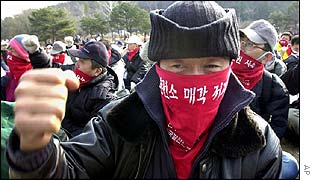 Campuses are a traditional rallying point South Korea's "illegal" strikes gained support on Tuesday as tens of thousands of manufacturing industry workers joined rail and power workers protesting against government privatisation plans.
Union leaders said it was unclear if the wider protests would be repeated on Wednesday.
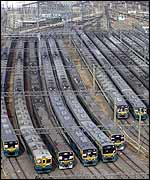
The Korean Confederation of Trade Unions (KCTU) said 130,000 members walked out for protest rallies in 22 cities. The Korea Employers Federation disputed the figure, saying 50,000 KCTU members took part. South Korean President Kim Dae-jung told a cabinet meeting the government must seek a dialogue with the unions and act with patience, although he said "illegal and violent acts must be sternly dealt with". 'Commuter war' The dispute meant more travel problems for commuters on Tuesday. About half of all passenger and freight rail journeys were cancelled, forcing traffic onto the roads and jamming major routes. The media dubbed it "commuter war".
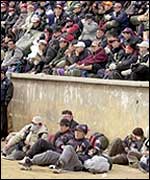
Colleges are traditional rallying points for anti-government activists, which correspondents say is a legacy of the pro-democracy student movement and the reluctance of police to enter campuses. But a strike by gas-industry employees has been called off after their leaders agreed to hold discussions with management. Escalating action The strike is supported by the country's two trade union umbrella groups.
They are also calling for improved working conditions, including the introduction of a five-day working week without a pay cut. Many South Koreans work six days a week, despite laws mandating a 44-hour working week, and last year, the average worker put in 20.4 hours overtime a week. The unions say they will continue their strike unless their demands are met. The financial markets shrugged off the strike, pushing the Korean share index above 800 for the first time in 19 months. | |
See also:  Internet links: The BBC is not responsible for the content of external internet sites Top Asia-Pacific stories now:  Links to more Asia-Pacific stories are at the foot of the page. | ||||||||||||||||||||||||
|
Links to more Asia-Pacific stories |
 | | ^^ Back to top News Front Page | World | UK | UK Politics | Business | Sci/Tech | Health | Education | Entertainment | Talking Point | In Depth | AudioVideo ---------------------------------------------------------------------------------- To BBC Sport>> | To BBC Weather>> ---------------------------------------------------------------------------------- © MMIII|News Sources|Privacy  |



 E-mail this story to a friend