 Al-Arian has been under investigation for many years |
The authorities in the United States have arrested a Palestinian university professor suspected of having links to terrorist groups. Sami al-Arian - who taught at a Florida university - is one of several people arrested in the US and abroad, the FBI said.
The charges against him are to be released at a court appearance later on Thursday.
Mr al-Arian has been under investigation since the early 1990s when he co-founded a now defunct Islamic studies think-tank, which the US Government considered a frontline organisation that raised funds for the Palestinian militant group, Islamic Jihad.
BANNED PROFESSOR Al-Arian has been subject of lengthy FBI investigation Used to run an Islamic charity Accused of funnelling money to Palestinian groups |
He has denied any links to terrorists and told reporters "it's all about politics," as he was led away in handcuffs. US Attorney General John Ashcroft is due to give more details on the arrests on Thursday.
Banned
Mr al-Arian is one of three people arrested in Florida, a fourth in Chicago, and an undisclosed number arrested overseas, FBI spokeswoman Sara Oates said.
A spokesman for the US attorney's office in Tampa, Florida, Steve Cole, said the arrests were related.
Mr al-Arian, who has lived in the United States since 1975, had never been charged with a crime.
He was banned from the University of South Florida grounds - where he taught computer engineering - after the 11 September attacks in a controversial decision condemned by human rights groups.
Mr al-Arian and his brother-in-law, Mazen al-Najjar, founded the World and Islam Studies Enterprises, raided by the FBI in 1995.
Mr al-Najjar - who also taught at the same university - was kept been detained without charge for about five years before being deported from the US last August.
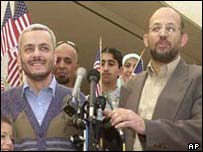 The academics complain of discrimination |
The academic caused controversy after being taped at a conference saying "Death to Israel" in Arabic. But he has denied having any ties to terrorist groups and has denied supporting Palestinian suicide attacks against Israeli civilians.
And he argues he is being discriminated for his political beliefs.
"I'm an Arab, I'm Palestinian, I'm a Muslim. That's not a popular thing to be these days," he said last year when Mr al-Najjar was deported.
"Do I have rights or don't I have rights?
"Right now it seems like a majority of the people think 'No, you don't have rights because you don't agree with us.'
"We will continue to fight this. I believe the issue is still academic freedom, the right to espouse views however unpopular," he vowed then.


 One-Minute World News
  News services
 Email this to a friend
  Printable version


