
|
 |
 | | | | | |||||||||||||||||
| | You are in: World: Americas | |||||||||||||||||||
 | | Wednesday, 3 April, 2002, 12:00 GMT 13:00 UK Falkland residents remember terror 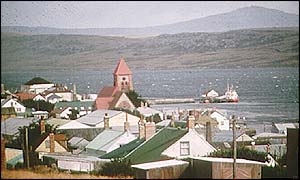 The small number of British troops were overwhelmed
The small cosy harbour town with its red telephone boxes could be found in any corner of Britain.
But 8,000 miles (12,800km) from Britain, deep in the South Atlantic, the Falkland Islands were the setting 20 years ago for one of the most bizarre wars of recent times. In April 1982, thousands of Argentine forces landed in the Falklands in an invasion involving army, navy and air force personnel. As their armoured personnel carriers drove along Ross Road on the Stanley waterfront, heading for Government House, Britain's Governor Rex Hunt was sounding defiant when he was interviewed by Falkland Islands Radio. "I'll talk to them, but I'm not walking out. I'm not surrendering to the bloody Argies, certainly not," Mr Hunt said famously. Forced down Within a few hours however, the few Royal Marines in Stanley, who had initially put up stiff resistance, found themselves overwhelmed and were forced to lay down their arms.
Brian Summers, the FIDF Company Sergeant-Major recalls the terror of the armoured personnel carriers (APCs) approaching. "We'd been forced to lie down on the main road, and we could feel the ground rumbling as the APCs drew closer. "We didn't know what to do. Do you lie there and let them roll over you, or do you jump up and get shot?" Deep shock For understandable reasons, the 20th anniversary of the Argentine invasion is not being marked by the people of the Falklands. However, their memories of 2 April, 1982 are as vivid as ever. The arrival of the Argentine troops came as a deep shock to local residents after 149 years of British rule over the Falklands. When it became clear that an Argentine invasion was imminent, Patrick Watts, the former manager of the Falkland Islands Broadcasting Station, kept his station on the air and broadcast a running commentary through the night, keeping islanders informed. When Mr Watts emerged from his studio at dawn, he was overwhelmed by what he found outside. "There were hundreds of Argentinian soldiers lolling around on my streets, my grass verges, my town, my country. "The realisation suddenly hit me and it really knocked me. "I felt very sad, very sick at that stage."
For the younger generation, it was at times an equally traumatic experience. "I remember peering out from my grandmother's house at some alien-looking people in green uniforms," recalls Lisa Riddell, who was 12 at the time. Ms Riddell who now edits the Falklands weekly publication, Penguin News, admits that for everyone who came through the conflict of 1982, there are some scars to bear. "Because of what happened, because people died, Falkland Islanders will always retain a certain feeling of guilt. "I don't think it's something we deserve to carry, but that feeling is there." Continuing commitment Twenty years later, high on the windswept summit of Mount Kent, overlooking Stanley, the British military have just re-dedicated a memorial to the sons of Kent who have fallen in conflicts around the world, including the Falklands War. There are nearly 2,000 British servicemen and women currently serving in the Falklands.
Although relations between Britain and Argentina have improved in recent years, Argentina still claims sovereignty over the Falkland Islands. "Threat is made up of capability and intent" explains the Commander of British Forces, Commodore Richard Ibbotson. "I would argue that Argentina retains a credible military capability. It is for them to decide whether they have an intent or not. "The very fact that there has been no further military adventurism towards these islands in the last 20 years means that deterrence has worked, and I wouldn't wish to see that change." For now, the people of the Falklands are awaiting 14 June this year when they will commemorate the 20th anniversary of the end of a war that changed not just their lives, but the Falkland Islands themselves. | | See also:  Internet links: The BBC is not responsible for the content of external internet sites Top Americas stories now:  Links to more Americas stories are at the foot of the page. | |||||||||||||||||
|
Links to more Americas stories |
 | | ^^ Back to top News Front Page | World | UK | UK Politics | Business | Sci/Tech | Health | Education | Entertainment | Talking Point | In Depth | AudioVideo ---------------------------------------------------------------------------------- To BBC Sport>> | To BBC Weather>> ---------------------------------------------------------------------------------- © MMIII|News Sources|Privacy  |



 E-mail this story to a friend