
|
 |
 | | | | | ||||||||||||||||||||||||||||||||||||||||
| | You are in: World: Americas | ||||||||||||||||||||||||||||||||||||||||||
 | | Friday, 22 March, 2002, 20:10 GMT Bush ties aid to reforms 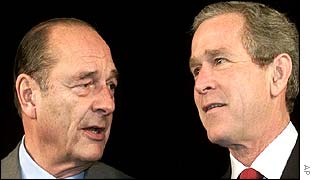 Mr Bush said aid should go to well-governed countries President George W Bush has told a United Nations conference against poverty that poor countries must undertake political, economic and legal reforms in order to get Western aid. In his keynote speech at the conference in Monterrey, Mexico, Mr Bush said: "Liberty and law and opportunity are the conditions for development."
French President Jacques Chirac echoed the sentiment, but the Cuban leader Fidel Castro has spoken against placing conditions on aid. UN Secretary General Kofi Annan has asked for an additional $50bn a year from rich nations to meet the conference's aim of halving the number of people living on less than $1 a day by 2015. Washington has however declined to endorse this, and believes that free trade and private investment hold the key to development. The conference ended with the adoption of a document calling for a new partnership between richer and poorer countries. Reform pledge "We must tie greater aid to political, legal and economic reforms, and by insisting on reform we do the work of compassion," Mr Bush told leaders of about 50 countries. "We must build the institutions of freedom, not subsidise the failures of the past." Responding to the call for more money, Mr Bush said he opposed the concept of measuring development aid only by the amounts given - rather than the results achieved. But in his address on Thursday, Cuban President Fidel Castro lashed out against conditions requested by Western nations. "You can't blame this tragedy on the poor countries. It wasn't they who conquered and looted entire continents for centuries, nor did they establish colonialism, nor did they reintroduce slavery, nor did they create modern imperialism," Mr Castro said. "They were its victims." Not enough The US has promised to increase foreign aid spending by 50% over three years from 2004, after an original plan set out by Mr Bush last week was criticised as not being enough. Critics have warned that rich countries - and in particular the US - are still not doing enough.
The US currently contributes just 0.1% of its gross national income, the lowest amount in the developed world. The conference adopted an agreement calling on wealthy countries to help reduce the poverty gap, and for poorer nations to use foreign aid more efficiently. Called the "Monterrey Consensus", the document envisages more financial aid from rich countries, increased foreign private investment in the developing world, lower trade barriers and debt relief. But critics say it did not go as far as many activists - and even some governments - had urged.
However, UN Secretary General Kofi Annan said it was "not a weak document, as some have claimed". "It will be weak if we fail to implement it. But if we live up to the promises it contains, and continue working on it together, it can mark a real turning point in the lives of poor people all over the world," Mr Annan said. | |
See also:  Internet links: The BBC is not responsible for the content of external internet sites Top Americas stories now:  Links to more Americas stories are at the foot of the page. | ||||||||||||||||||||||||||||||||||||||||
|
Links to more Americas stories |
 | | ^^ Back to top News Front Page | World | UK | UK Politics | Business | Sci/Tech | Health | Education | Entertainment | Talking Point | In Depth | AudioVideo ---------------------------------------------------------------------------------- To BBC Sport>> | To BBC Weather>> ---------------------------------------------------------------------------------- © MMIII|News Sources|Privacy  |




 E-mail this story to a friend