
|
 |
 | | | | | ||||||||||||||||||||||||||||||||||||||||||||||
| | You are in: World: Americas | ||||||||||||||||||||||||||||||||||||||||||||||||
 | | Monday, 18 March, 2002, 12:53 GMT Little promise from Monterrey 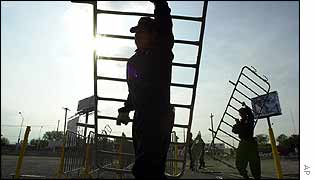 Police erect barriers ahead of expected protests
The Monterrey conference aims to go some way towards achieving the ambitious goals of the UN's Millennium Declaration of September 2000 - reducing global poverty by half and creating universal primary education by the year 2015. But there is a growing consensus amongst development economists and activists that the conference is unlikely to improve the lot of the poor.
"The US has also insisted that the Monterrey Consensus is the final document and can't be altered during the conference. Effectively, it's a done deal." Much of the emphasis of the document is on global trade and the need for developing nations to put in place "sound" economic policies.
"This is just shorthand for reducing spending on social programmes and getting rid of any subsidies that protect our farmers," says Maria Atilano, from the Mexican Network Against Free Trade. "There are double standards here because there is no commitment from the developed world to scrap the $300bn spent every year on price support measures for its own farmers." No targets There is also disappointment from charities such as Oxfam over the apparent failure to fix targets for increased aid to the developing world. "The impact of aid on developing nations can't be underestimated," Oxfam's Central America media coordinator Luis Clemens says.
"Corruption levels in poorer nations have fallen and that means the aid really does get to the people who need it." In the last decade, global financial aid has fallen by 20% to just over $50bn a year. Aid agencies have been joined in an unlikely alliance with the World Bank, which is calling for a doubling of aid over the next five years. "That's the only way that some of the goals of the Millennium Declaration can be met," says World Bank chief economist Nick Stern. Marches Another concern amongst activists in the developing world is the vague references to debt relief included in the Monterrey Consensus. "We want widespread debt relief and not just relief that's dependent on developing nations being forced to put in place neo-liberal economic policies," says Liliana Benavides, who heads a Latin American debt relief group called El Barzon. With little scope for changes to be made to the Monterrey agenda over the coming week, it seems unlikely that many of these concerns will be addressed in the final declaration signed by heads of state on Friday. With such little room for manoeuvre, it is perhaps likely that much of the media attention this week will focus on a parallel set of meetings being organised by non-governmental organisations in the city. They are planning marches and protests outside the main conference centre to bring their concerns to the attention of the world's media that have gathered in Monterrey. | |
See also:  Internet links: The BBC is not responsible for the content of external internet sites Top Americas stories now:  Links to more Americas stories are at the foot of the page. | ||||||||||||||||||||||||||||||||||||||||||||||
|
Links to more Americas stories |
 | | ^^ Back to top News Front Page | World | UK | UK Politics | Business | Sci/Tech | Health | Education | Entertainment | Talking Point | In Depth | AudioVideo ---------------------------------------------------------------------------------- To BBC Sport>> | To BBC Weather>> ---------------------------------------------------------------------------------- © MMIII|News Sources|Privacy  |






 E-mail this story to a friend