
|
 |
 | | | | | |||||||||||||||||||||||||||||
| | You are in: World: Americas | |||||||||||||||||||||||||||||||
 | | Friday, 8 March, 2002, 17:48 GMT War on Terror: Six months on 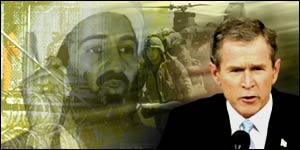 Six months after the suicide attacks on the United States and the launch of the "war on terror", BBC News Online charts the progress to date of the US-led campaign. Click on the links to read about: As fighting in eastern Afghanistan enters a second week, it has become clear that many of Osama Bin Laden's fighters stayed in the country after the fall of the Taleban in December. Initial US estimates put the number of fighters holed up in the mountains near the city of Gardez at 150 to 200.
According to some local people, as many as 2,000 rebels - thought to be mostly Pakistanis, Uzbeks and Chechens - moved into the area after the southern Taleban stronghold of Kandahar fell in December. The Pentagon has repeatedly warned that pockets of resistance remain in different parts of the country. The ferocity of the fighting around Gardez has led to speculation that the rebels may be defending their leader. However, the Pentagon says it does not know whether Osama Bin Laden is still in Afghanistan or even if he is still alive. It has asked Bin Laden's relatives to provide DNA samples to determine if human remains found last month in Afghanistan are those of the terror group leader. Many al-Qaeda and Taleban fighters are believed to have fled Afghanistan as pro-US forces gained ground last year. It is thought that many of those involved in a fierce battle around the caves of Tora Bora in December fled over the mountains to Pakistan. Pakistan has deployed additional forces in the border region - but it is a difficult area to police and security matters are usually left to local tribesmen, many of whom are said to be sympathetic to Bin Laden. It is believed there are many other places which Bin Laden and his supporters could have fled to, including:
US forces in Afghanistan captured hundreds of suspected Taleban and al-Qaeda fighters, including at least one US citizen as well as numerous European nationals. Some 300 are now in custody at a US military base in Guantanamo Bay, Cuba. Others are being held at a base near Kandahar.
More than 1,000 people were detained in the US after the attacks. A French citizen has been charged for suspected links to the suicide hijackers. A British man - with suspected al-Qaeda links - has also been charged in the US with plotting to blow up a transatlantic flight in December. In Europe, dozens of people have been arrested on terrorism charges in the UK, Germany, Spain, France, Italy and Turkey. Last month, the Italian authorities said they foiled an attack on the US embassy and charged several men with alleged ties to Bin Laden. African, Asian and Middle Eastern countries have also arrested dozens of suspected Islamic extremists since the US declared war on al-Qaeda. The war in Afghanistan has led to new deployments of US troops - even in countries seen as part of Russia's traditional sphere of influence.
Five US military advisers have also arrived in the former Soviet republic of Georgia. Reports say up to 200 special forces may be deployed there. The Americans are training Georgian forces, after reports that al-Qaeda fighters fleeing Afghanistan may have entered the country. However, the biggest US training operation is taking place in Philippines, at the invitation of the government. The Pentagon is sending 650 troops to prepare the local forces searching for Abu Sayaff rebels, who reportedly have links to Bin Laden. Yemen has also said it will receive up to 100 US military advisers, who will provide training and advice for Yemeni military and security forces. Where next in the war on terror? Afghanistan is just the beginning, Washington has warned, and there has been much speculation about who will be the next target in America's campaign.
There are growing signs that the next country on Washington's list is Iraq. In an address to the nation earlier this year, President Bush singled out Iraq, Iran and North Korea as part of an "axis of evil" - states believed to be developing weapons of mass destruction. He has since said that he would welcome dialogue with North Korea and Iran. US Secretary of State Colin Powell said recently that the Iraqi regime "ought to change or ought to be changed". Mr Powell said US allies would be closely consulted before any action was taken against Iraq, but warned that America reserved the right to act alone. | |
Top Americas stories now:  Links to more Americas stories are at the foot of the page. | |||||||||||||||||||||||||||||
|
Links to more Americas stories |
 | | ^^ Back to top News Front Page | World | UK | UK Politics | Business | Sci/Tech | Health | Education | Entertainment | Talking Point | In Depth | AudioVideo ---------------------------------------------------------------------------------- To BBC Sport>> | To BBC Weather>> ---------------------------------------------------------------------------------- © MMIII|News Sources|Privacy  |





 E-mail this story to a friend