
|
 |
 | | | | | |||||||||||||||||||||||||||||||||||||||||||||
| | You are in: World: Americas | |||||||||||||||||||||||||||||||||||||||||||||||
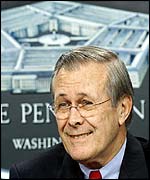
 | | Wednesday, 27 February, 2002, 19:09 GMT US sorting terror suspects for trials  US has concentrated on the threat of future attack Terror suspects captured in Afghanistan are being questioned to see if they should face US military tribunals or another form of justice. US Defence Secretary Donald Rumsfeld said there were six options for the 500 men being held in Camp X-Ray in Guantanamo Bay and in Afghanistan.
He said the Pentagon was keen for the detainees to be tried in their home countries, but it was also up to the US Department of Justice and President George W Bush to make the final decisions. Those not tried by a military tribunal would be prosecuted in a US civilian or US military court, returned to their home countries for prosecution, released outright or held in US custody indefinitely, Mr Rumsfeld said. The detainees come from more than 24 countries, some of which - for example Saudi Arabia and Britain - have asked for their citizens to be repatriated for prosecution. "We, in most cases, prefer to have people go back to their own countries and be tried there. We want as little of this as we can possibly do," said Mr Rumsfeld on behalf of the military. US emphasis When the Pentagon first announced plans to establish military tribunals, it faced a storm of criticism from human rights groups, as well as complaints from close allies. Opponents feared that suspects would lack the legal protections offered in criminal courts and that trials might be conducted in secret without outside scrutiny.
Interrogators at Guantanamo Bay and in Afghanistan have been interested more in their knowledge of future attacks, and the whereabouts of Osama Bin Laden, rather than their past activities. But Mr Rumsfeld said the first round of processing prisoners was to get such information about the situation on the ground. The second round of interrogations aimed at building a legal case against prisoners had now begun and the Pentagon had a clear idea of how the military commissions would be structured. He said he would not reveal any details of how the tribunals would function until the entire legal framework had been completed. Repatriations Of a total of 494 people, 194 are being held at two centres in Afghanistan, while 300 have been flown to the US naval base in Guantanamo Bay, Cuba. The Pentagon initially asserted that the prisoners were "unlawful combatants" with no rights under the Geneva Convention. However, the White House decided in February that the convention applied to the Taleban prisoners, but not to those suspected of al-Qaeda membership. But it said none of the detainees would be given prisoner of war status - with the rights and guarantees connected with such status - despite the objections of the International Committee of the Red Cross and some US allies. | |
See also:  Internet links: The BBC is not responsible for the content of external internet sites Top Americas stories now:  Links to more Americas stories are at the foot of the page. | |||||||||||||||||||||||||||||||||||||||||||||
|
Links to more Americas stories |
 | | ^^ Back to top News Front Page | World | UK | UK Politics | Business | Sci/Tech | Health | Education | Entertainment | Talking Point | In Depth | AudioVideo ---------------------------------------------------------------------------------- To BBC Sport>> | To BBC Weather>> ---------------------------------------------------------------------------------- © MMIII|News Sources|Privacy  |




 E-mail this story to a friend