On World Sight Day, the BBC's Caroline Pare reports for the Radio 4 programme, On a Wing and a Prayer, from an "eye safari" in north-eastern Kenya. Some have been blind for years |
Flying over the deserts of north-eastern Kenya, towards the Somali border, there is nothing as far as the eye can see, no sign of settlement. Below us the people are largely camel herders.
I am accompanying what's called an "eye safari". There are three surgeons, five nurses and a ton of equipment on board.
They will spend the week with these nomads bringing sight to the blind.
Our destination is the town of Wajir. The pilot is a missionary for Mission Aviation Fellowship and without these planes the people of Wajir would see few doctors.
The District Hospital is a single story colonial-style series of buildings around a central courtyard and when the team arrive the courtyard is full of people - women wrapped in brightly coloured cloths and men with beards died with henna and turbans.
The hospital administrator, Dr Mbithi, tells me the hospital serves a huge area with 500,000 people and he is the only medical doctor here.
Around 10% have eye problems. For him the flying doctors are a lifeline.
Police called
The three doctors are shown into a small room full of boxes where they are to screen the 250 or so patients who have turned up to see who requires eye surgery.
But things do not go to plan. Immediately the doctors arrive, the crowd presses against the office door.
They are so persistent that it is impossible for the nurses to get in.
Patients cannot get out to let others take their place.
Dr Mbithi, the administrator, tells me later that someone is even stabbed in the chaos.
It is only when police are called that the crowd settles down enough for work to start.
Most of the patients are elderly women. They speak only Somali and are blind.
It is as hard for the Kenyan surgeons, Francis Ole Sempele and Maurice Abony to communicate with them as it is for Dan Grabin, an American.
No mistakes
The majority of the cases are cataracts. In this area cataracts often start when people are in their 40s, whereas in the UK people normally do not get them until their 60s or 70s.
Some of the cases are very acute - patients who are completely blind and who have probably been so for months if not years.
 Just three surgeons treated 140 people in a single day |
Dan Grabin says these are the most satisfying for him. He knows he will be able to help them.
A quick operation and they will see again.
It is crowded. The three doctors and two nurses all seeing patients at one time. "Kalinka, kalinka". The word is used so often I now know it means "operate".
And, to ensure there are no mistakes during the following day's theatre, each patient has a sticker with an L or an R scrawled on it stuck on their brow above the eye to be operated on.
They assess the last of the patients at around 2000.
The list for the next day's surgery is totted up - 140 operations.
I am astounded and cannot believe they will accomplish it with just three surgeons.
No running water
The next morning the team arrives at 0630.
The courtyard is covered with mosquito nets slung under the trees.
Many of the patients have spent the night here.
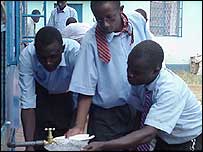
Kenya's only school for the blind 
|
The operating theatre looks like an ordinary, rather dusty, room to me.
There are three operating tables squeezed inside, each with a microscope attached to it.
By each bed is a table for the instruments and a saline drip bag hanging from a stand.
There is no running water as the surgeons scrub up. And on the floor more instruments are boiling in a huge pan.
The first patient of the day is lead into the anteroom where nurse Joyce Mwangi cleans and expertly anaesthetises the eye with an injection to the muscles behind it.
Then they are lead to one of the beds where the operation starts.
Speed is of the essence and communication problems mean that nothing happens quickly.
But once a patient is on the operating table and the beam of light from the microscope has swung onto the eye everything goes smoothly.
Human conveyor belt
The cataract operation involves cutting into the eye ball to access the lens capsule
The occluded lens matter that is causing the problem is emptied out and in its place is put a tiny glass lens, like a miniature contact lens.
Then the wounds are closed and the patient is off. It takes little more than five minutes.
The team work solidly all day. They do not finish until 2030.
The moment of truth comes the next morning when the patches are taken off.
The 140 patients are lined up in the courtyard and down the line come the posse of doctors and nurses, taking off the patches, holding up fingers to check there is vision, administering drops and then on to the next person.
It is like a human conveyor belt.
The smiles on the faces tell the story. The surgeons are pleased with their work.
All the patients can see. But there is no time to waste.
The medical team leaves immediately for the plane to be flown off to the next town, Mandera, and the next crowd of blind people.
The five-part series, On A Wing And A Prayer, is being broadcast on Radio 4 on Tuesdays at 0830 GMT (0930 BST).


 One-Minute World News
  News services


 E-mail this to a friend
  Printable version
 In pictures