 Monrovia residents are trapped by the fighting |
A team of military experts has arrived in Liberia to prepare the ground for an international peacekeeping force. The fact-finding mission - consists of officers from the United States, Britain and five West African countries - flew in from neighbouring Ghana as fighting between government forces and rebels continued in the capital, Monrovia.
Meanwhile, the US has introduced a draft resolution on Liberia at the United Nations, calling on the Security Council to authorise a peacekeeping force.
The resolution would allow UN troops to use force if necessary.
The military experts arrived in the Monrovia in an eight-vehicle convoy bearing computer-printed sheets stuck to the doors with tape to identify them.
The BBC's Paul Welsh, in Monrovia, reports that there are hopes that a force of thousands of troops could follow soon.
But he adds that although momentum for an intervention force is growing, the fighting continues - and so does the killing of civilians and the suffering of thousands who are trying to find shelter from this war.
'Rare case'
The UN Secretary General, Kofi Annan, has asked the Security Council to come up with a robust mandate for the peacekeepers.
Mr Annan said this was a rare case where, even though a ceasefire had broken down, both sides in the conflict - as well as the Liberian people - wanted an international force to step in.
 |  Monrovia is a living hell Monrovia is a living hell  |
There has been wrangling about the terms of deployment for the force, which in the first instance will be made up of West African troops largely from the regional military power Nigeria, and how the operation will be paid for and supported. Mr Annan said: "The West African leaders made it clear that they will be prepared to send in troops, but that they will need financial and logistical support, including airlifts.
"Now they have their two battalions ready to go, we will move one in from... Sierra Leone and the other will come in from Nigeria."
The US is sending its own seaborne force, but it has no orders to deploy on shore.
The BBC's David Bamford, at the UN in New York, says the thinking is that the West African peacekeepers will be quickly reinforced by additional troops from outside the region.
Mr Annan has expressed his hope that the Americans will be among them, if not leading them.
The Pentagon has said it is "too early" to say whether US marines - expected in warships on Thursday off Liberia's coast - will aid the West African force in helping to bring about an end to fighting.
Humanitarian crisis
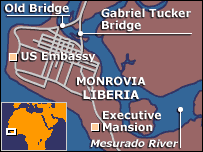
On the ground in Liberia, fierce exchanges of gunfire were heard at two strategic government-held bridges, which offer access to central Monrovia from the rebel-held port area.
Earlier, the Liberian Government rejected an offer from the main rebel group, Lurd, to suspend hostilities if its fighters were allowed to remain there until peacekeepers arrived.
Click below to see a map of key places and rebel offensives 
|
The embattled government is insisting that the rebels end their offensive, which is now in its 11th day, and leave the city. Conditions in Monrovia are said to be appalling, with increasing numbers of children facing malnourishment as food and water supplies run dangerously low.
Prices are soaring and the country's staple food, rice, is running out fast.
Rebels control the capital's food stocks in the port area and have been accused by the government of looting - though they say they have simply been handing out food to the hungry.
Another rebel group captured Liberia's second city, Buchanan, earlier this week, cutting off the last remaining route for food imports to get to government-held parts of the capital.
International aid groups say they can do little to help the 1.3 million people trapped in the city.
The rebels are trying to overthrow President Charles Taylor, who has been indicted by a United Nations-backed war crimes tribunal in Sierra Leone.
He has agreed to quit and accept asylum in Nigeria - but only after peacekeepers come to Liberia.


 One-Minute World News
  News services
 E-mail this to a friend
  Printable version

 Enlarge Map


