
|
 |
 | | | | | ||||||||||||||||
| | You are in: World: Africa | ||||||||||||||||||
 | | Friday, 29 March, 2002, 16:24 GMT Visiting Cameroon's palm wine capital  Ten litres of palm wine smooth marriage proposals
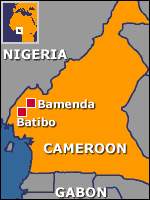
Batibo is a relatively big cluster of villages located some 40 kilometres from the provincial capital, Bamenda.
This is the highest amount of palm wine produced anywhere in Cameroon and this has inadvertently led to Batibo being called the palm wine capital of Cameroon. I visited the area to check out for myself if the village did indeed merit the name. Social lubricant Mbatifuh Thomaas Mbacheck is the palm-wine-drinking mayor of Batibo rural council. "If people say Batibo is the palm wine capital, I should shake my head and be proud of that," he says.
He admits that nothing serious happens in the 22 districts that make up his municipality without the conspicuous presence of palm wine known locally as "fitchuk". "I do drink palm wine" he told me. He took me to one of the numerous palm wine markets in the area where we got to sample the goods. "Every Batibo man, except for restrictions of health, drinks palm wine. I think it is one of the reasons that makes the Batibo man very social," he said. Not drunkards In real figures, the mayor says palm wine is the third highest income-earner for his municipality, since transporters have to pay taxes to transport the wine for sale to other areas of Cameroon.
Though palm wine does have a high percentage of alcohol, the mayor refuses to accept that Batibo people are by implication mostly drunkards. He however acknowledges that a few people do get drunk especially during social functions when palm wine is in plentiful supply. Family business The day usually begins early for palm wine tappers or farmers in Batibo. They have to leave home early to go into the bush and tap the whitish wine from raffia palms.
One of the tappers Njouny Gilbert says a tapper must be up and about by 0500 because in the early hours of the morning, dozens of truck drivers and bike transporters are already buying palm wine to send across Cameroon's nine other provinces where there is always a ready market. Teku Simon, 42, has an old bike he says he has been using to transport and sell palm wine for the past 15 years. Though he admits some people in the villages also grow cocoa and coffee, he says palm wine selling and retailing is the most popular business in the area. Most tappers and transporters inherited the palm wine business from their parents, I was told. Marriages - Batibo style To marry a Batibo girl, all suitors must provide a mandatory 10 litres of palm wine, which the bride must share with the groom as a sign that they will share everything as married partners. The suitor also has to take along an assortment of other good, including beer, salt and oil to his future in-laws, but palm wine must always be included.
"I don't want any boy to bring whisky to win the hand of my daughter," a mother with two unmarried daughters told me. She added that most Batibo people in the village did not even know what whisky looks like, let alone how it tastes. "Palm wine is what every parent wants," she added smiling. I told her I would soon be knocking on her door with my 10 litres of palm wine for one of her daughters, easily understanding why Batibo was known as the palm wine capital. To which she replied that she was looking forward to my return. | | See also:  Internet links: The BBC is not responsible for the content of external internet sites Top Africa stories now:  Links to more Africa stories are at the foot of the page. | ||||||||||||||||
|
Links to more Africa stories |
 | | ^^ Back to top News Front Page | World | UK | UK Politics | Business | Sci/Tech | Health | Education | Entertainment | Talking Point | In Depth | AudioVideo ---------------------------------------------------------------------------------- To BBC Sport>> | To BBC Weather>> ---------------------------------------------------------------------------------- © MMIII|News Sources|Privacy  |



 E-mail this story to a friend