
|
 |
 | | | | | |||||||||||||||||||||||||
| | You are in: World: Africa | |||||||||||||||||||||||||||
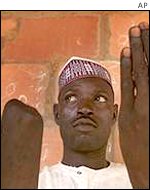
 | | Tuesday, 26 March, 2002, 00:12 GMT Nigeria in crisis over Sharia law  An international campaign backed Safiya
The Nigerian Government is coming under increasing international pressure to amend laws in northern Muslim areas which call for punishments such as stoning, amputation and flogging. Although one woman, Safiya Huseini, won her appeal on Monday against a sentence of death by stoning for committing adultery, another has now been sentenced to the same punishment.
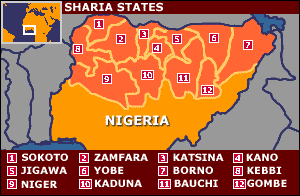
The issue of Islamic law has provoked a deep constitutional crisis in Nigeria. The law not only insists on stoning for adultery, but also amputation for theft and flogging for the lesser Islamic crimes of alcohol consumption and sex before marriage. Safiya Huseini won her case after the Sharia court in the northern town of Sokoto said the original ruling was unsound. Click here for a map of Sharia states Smiling broadly, she was surrounded by the world's media as she held her one-year-old daughter in her arms. Case dismissed It was the conception of Safiya's child out of wedlock that had been proof enough at the first trial of her adultery. But in Monday's ruling, judge Mohammed Tambari-Uthman said that because the alleged act had taken place before adultery became a criminal offence under Islamic law, her case should be dismissed. Under Sharia law as practised in northern Nigeria, pregnancy outside marriage is sufficient evidence to convict a woman.
In contrast, four eye-witnesses are required for a man to be found guilty of adultery. The man named by Ms Lawal as the father of her baby girl admitted they had a relationship but denied having had sex with her. Charges against him were dropped after no witnesses came forward. Ms Lawal now has 30 days to appeal against the sentence or she faces being stoned in eight months' time - when she has finished breast-feeding her daughter. Nigeria's federal government - under severe international pressure - has condemned the strict punishments handed down by Sharia courts. Muslim leaders united But in response, authorities in the north are equally adamant that the Sharia legal code is something all good Muslims should live their lives by. Of particular concern to human rights organisations is the increasing unanimity among northern political leaders over the issue of Sharia punishments. President Olusegun Obasanjo, himself a devout Christian, has said he would prefer more humane punishments to be handed down by the Sharia courts. But he stopped short of condemning Islamic law outright, stressing that Nigeria is a complex multi-religious country. Racial tensions Mr Obasanjo finds himself in a difficult position. Nigeria has seen violent clashes between Muslims and Christians over the issue of Sharia, and to fan the flames of these tensions would be dangerous to the country's stability. Now that Justice Minister Kanu Agabi has declared certain Sharia punishments discriminatory and therefore unconstitutional, the government has for the first time made its position clear. With the northern states indicating that they intend to ignore the minister's intervention, the stage is clearly set for a constitutional battle. | |
See also:  Internet links: The BBC is not responsible for the content of external internet sites Top Africa stories now:  Links to more Africa stories are at the foot of the page. | |||||||||||||||||||||||||
|
Links to more Africa stories |
 | | ^^ Back to top News Front Page | World | UK | UK Politics | Business | Sci/Tech | Health | Education | Entertainment | Talking Point | In Depth | AudioVideo ---------------------------------------------------------------------------------- To BBC Sport>> | To BBC Weather>> ---------------------------------------------------------------------------------- © MMIII|News Sources|Privacy  |




 E-mail this story to a friend