
|
 |
 | | | | | |||||||||||||||
| | You are in: World: Africa | |||||||||||||||||
 | | Thursday, 28 March, 2002, 21:28 GMT Sudan's forgotten refugees  Hundreds of Sudanese have fled to the CAR this year
Rafael Calezo had been walking for five months when he arrived in the Central African Republic this week. Dressed in trousers held up by string and a torn shirt, he was carrying his silent, malnourished daughter.
The 700 refugees who have entered the Central African Republic's eastern province Haut-Mbomou this year are a reminder that Sudan's three-decade civil war between southern rebels and government forces rages on. They fled in September following the fall of the rebel-held town of Raga to government troops, and travelled 600 kilometres (375 miles) on foot. Leprosy "When the government troops came there was bombing and many deaths," Adula Hissan, a trader, says. "Then soldiers from both sides burnt down our houses and looted our shops."
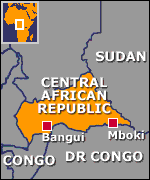
"All these refugees have parasites and many have malaria. The men have hernias from carrying children. There are also cases of leprosy," said a doctor from Medecins Sans Frontieres. The remote town of Mboki, situated 2,400 km by road east of the capital Bangui, was designated by the government for the resettlement of Sudanese following the first influx of refugees in 1965.
"We are expecting another several thousand refugees to arrive during the next few weeks. They are still in the bush. We don't know how the town is going to provide for them," said the head of the Mboki refugee committee, Peter Binza. Funding problems Barely connected to the outside world - the last time the postal service operated was 1974 - Mboki has little means to assist the refugees. Money only circulates when a government aeroplane arrives with civil servants salaries - the last time wages were paid was January 2001. "Because we're located so far from Bangui, nobody cares what happens here. Now everybody is working on the land to produce food to survive," said Alphonse Gbanda, the mayor.
The two organisations have an agreement to run the hospital, but recently the UNHCR has cut its funding, arguing that the local Red Cross does not spend all the money it receives for the hospital on the project. Earlier this month the Red Cross closed the hospital, a move which doctors say has led to the deaths of at least 14 patients. The hospital has since reopened, but this week was operating with a voluntary staff of nine. "As people know the hospital is not functioning they're choosing to die at home," said Arthur Maka, acting head of the hospital. Fighting continues The schools are also scarcely operating amid accusations from the refugees that the government is replacing teachers who speak Arabic and English, the same languages as the Sudanese, with French-speaking teachers.
Aid to maintain the wells has also gone astray which means much of the water in the town is no longer portable The Central African Republic has good relations with Sudan, so the government has little interest in the welfare of refugees from the rebel-held south. "The world has forgotten the war in Sudan," refugee Mossa Dionysius says. "But the fighting continues and people are still fleeing. We sincerely hope international assistance is not withdrawn, especially for the new arrivals." | | See also:  Top Africa stories now:  Links to more Africa stories are at the foot of the page. | |||||||||||||||
|
Links to more Africa stories |
 | | ^^ Back to top News Front Page | World | UK | UK Politics | Business | Sci/Tech | Health | Education | Entertainment | Talking Point | In Depth | AudioVideo ---------------------------------------------------------------------------------- To BBC Sport>> | To BBC Weather>> ---------------------------------------------------------------------------------- © MMIII|News Sources|Privacy  |



 E-mail this story to a friend