
|
 |
 | | | | | ||||||||||||||||||||||||||||||
| | You are in: World: Africa | ||||||||||||||||||||||||||||||||
 | | Wednesday, 20 March, 2002, 03:43 GMT Mugabe and unions on collision course 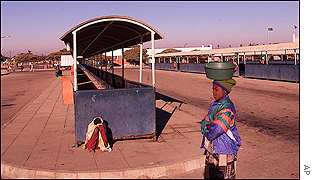 Previous strikes have shut Zimbabwe down
The Zimbabwe Congress of Trade Unions, ZCTU, was by far the most powerful group involved in the creation of the Movement for Democratic Change in 1999. The MDC candidate who officially lost the recent presidential election, Morgan Tsvangirai, led the organisation until he entered the political arena.
"What we are doing has nothing to do with politics and it is purely about the infringements of our freedoms," ZCTU president Lovemore Matambo told the BBC's Network Africa. He even said that the unions had supporters from both the ruling Zanu-PF party, as well as the MDC. But the authorities will doubtless see the strike as a political move and the leaders may well be arrested if they do not back down. 'Act now' A new security law gives the president the power to declare any strike illegal. All public demonstrations - including protests by striking workers - now require prior police approval.
Under the same legislation, policemen walked into a meeting of ZCTU leaders last week and refused to leave, saying that it was a political meeting. This incident sparked the strike and Mr Matambo says: "If we don't act now, there is a high likelihood that there will be no labour movement in this country - and that is what the state is looking for." He admits that the unions were also worried by what he called the "disenfranchisement" of urban workers during this month's election but denies that was why the strike was called. 'Lawlessness' As Zimbabwe's economy has gone into freefall in recent years, the unions have increasingly taken a political role. Led by Mr Tsvangirai, the ZCTU argued that the declining living standards of workers were not caused by employers - generally the cause of strikes - but by government mismanagement of the economy.
Since December 1997, a series of strikes and stay-aways have been called demanding that tax rises be reversed, that prices of bread and petrol be reduced, that Zimbabwe withdraw from the war in DR Congo and that government "lawlessness" end. These have generally been well heeded by Zimbabwe's workers but have only had mixed success in changing government policy. The police broke up that first strike and ever since the unions have tried to limit violence by not staging mass marches but instead calling on workers to stay at home. Mr Tsvangirai and many of the current ZCTU leadership will privately be hoping that the three-day stay-away will be extended, ultimately forcing Mr Mugabe out of office. But he does not back down easily and all diplomatic efforts to calm Zimbabwe's political temperature might well be doomed to failure. | |
See also:  Internet links: The BBC is not responsible for the content of external internet sites Top Africa stories now:  Links to more Africa stories are at the foot of the page. | ||||||||||||||||||||||||||||||
|
Links to more Africa stories |
 | | ^^ Back to top News Front Page | World | UK | UK Politics | Business | Sci/Tech | Health | Education | Entertainment | Talking Point | In Depth | AudioVideo ---------------------------------------------------------------------------------- To BBC Sport>> | To BBC Weather>> ---------------------------------------------------------------------------------- © MMIII|News Sources|Privacy  |




 E-mail this story to a friend