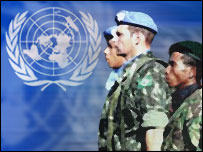
 The council has five permanent and 10 non-permanent members |
Reform of the United Nations Security Council is the principal focus of change for the world body. UN Secretary General Kofi Annan has said the council lacks the confidence of many states and is not representative of current geopolitical realities. BBC News Online looks at the countries that are laying claims to a greater role on the council - perhaps veto power and a permanent seat.
The current situation:
All the important decisions at the United Nations are made at Security Council. The council's resolutions have the authority of international law and are binding on all UN members.
The United States, China, Russia, the United Kingdom and France have permanent seats in the council and the power to veto a resolution. This arrangement reflects the geopolitical situation at the end of World War II. After the big five, there are 10 spaces on the council to which the remaining 186 UN members can be elected for a two-year term. These 10 non-permanent members do not have veto power.
The leading contenders:
Japan is probably the leading contender for a permanent council seat. It is a major economic power and, after the United States, the second largest contributor to UN coffers. Japan's contribution to UN peacekeeping forces has increased in recent years. South Korea has opposed a permanent Japanese seat, citing the brutality of Japan's 35-year occupation of South Korea. Japanese officials have indicated that they would like veto power, but that it would not be used.
UN operations, finances and spending 
|
Germany also has a strong case. It is a leading economic power and contributor to UN coffers - the third largest contributor with 9.6% of the budget. More than 9,000 German soldiers are serving as peacekeepers, mainly in Afghanistan. Britain and France back Germany's claim to a seat, but neither is willing to give up its own. The German case is slightly undermined because it would become a third European member on the council. India, the most populous democracy in the world, also has a strong case for a seat on the council. One of the reasons the council is believed to lack legitimacy is that all its members are from the industrialised "north". Pakistan vehemently opposes a permanent council seat for India. Some have argued that inviting India onto the council might also be perceived as rewarding Delhi for developing nuclear weapons.
Brazil is probably the strongest South American candidate, though it is a Portuguese-speaking country in a Hispanic region.
Other contenders:
There is some support for a permanent African seat on the council. South Africa, Nigeria and Egypt are all making their case. South Africa is believed to be the favourite of the African nations.
Mexico, Argentina and Indonesia are also in the frame.


 One-Minute World News
  News services

 E-mail this to a friend
  Printable version
  The Council [needs] to regain the confidence of states, and of world public opinion - both by demonstrating its ability to deal effectively with the most difficult issues, and by becoming more broadly representative of the international community as a whole, as well as the geopolitical realities of today
 At-a-glance