|
 |
 | | | | | | ||||||||||||||||||||||||||||||||||||||||||||||||||||||||||||||||||||||||||||||||||||||||||||||||||||||||||||||||||||||||||||||||||||||||||||||||||||||
| | | You are in: Science/Nature | ||||||||||||||||||||||||||||||||||||||||||||||||||||||||||||||||||||||||||||||||||||||||||||||||||||||||||||||||||||||||||||||||||||||||||||||||||||||||
|
| | Monday, 11 November, 2002, 11:42 GMT Cod farming 'could replace wild catch' 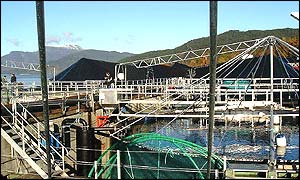 In Norway, cod are being farmed like salmon
For the second year running, the International Council for the Exploration of the Seas has called for an end to cod fishing, to prevent the extinction of the species. In Norway cod farming is now being presented as a solution to this problem. The aquaculture industry here says a few fish farms will be able to deliver many times the country's wild catch of cod in a few years' time.
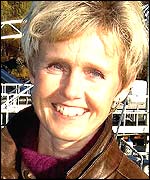
These fish could be on our dinner plates in less than two years. Marit Solberg is managing director of Marine Harvest Norway, the company which owns the fish farm. She told BBC News Online she had great hopes for the future. "I'm very optimistic about cod farming. I think it will increase gradually in the next five years. "In ten years' time we will be up to maybe 400,000 tonnes of farmed cod in Norway." If Ms Solberg's predictions come true, it would be a remarkable development - 400, 000 tonnes of farmed cod is double Norway's entire annual wild cod quota. Complex life cycle So why didn't anyone think of this before? As the world's leading salmon farming nation, Norway enjoys a high level of aquaculture expertise.
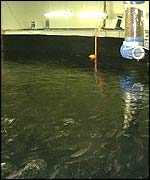
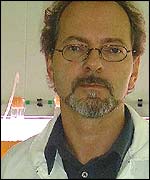
But it is the early stages of the life cycle of cod which have presented scientists with serious challenges. The first commercially farmed cod all started their lives at Cod Culture Norway, a high-tech hatching facility outside Bergen, Norway. Here advanced laboratory experiments take place in one room, while cod swim around in huge water tanks in the next. Finn Christian Skjennum runs the plant. He has developed a technique whereby the plant produces plankton and minute crustaceans, which the cod larvae and fry need in order to grow. "In cod we have to give live feed organisms. For salmon you can just go directly on to dry feed," Mr Skjennum explained. "This is creating a lot of challenges. We need to be in control of all of the steps. The size of the larvae we are working with are much, much smaller than salmon." The experiments at Cod Culture Norway seem to have paid off. This year, 300,000 cod fry were born, hatched and raised to farming size there. The total annual capacity of the plant is four million fry. Mr Skjennum and others in the industry are in no doubt that cod farming will soon be a significant industry, perhaps bigger than salmon farming. The possibilities for profit are considerable. Last year the Norwegian aquaculture business was worth more than $1.2bn. Environmental concerns But not everyone is equally enthusiastic about the speed with which cod farming is developing. Maren Esmark, marine conservation expert for WWF Norway, told BBC News Online the organisation feels things are moving too fast:
"We do know from salmon farming that we have a problem with transferral of parasites and disease to wild fish. "We have a problem with escaped fish and with the discharge of nutrients and toxics. And all this will come with cod farming," she said. WWF Norway and other environmental organisations say cod farming should not be seen as a solution to the disappearance of wild cod. They are calling for governments to follow the advice of the International Council for the Exploration of the Sea, and cut the quotas for wild cod catches, before concentrating on farming the fish. The Norwegian fish farming industry says it has learnt from the mistakes it made in salmon farming, and that cod farming is safe - and here to stay. In the end though, the proof is in the eating. There is no saying whether consumers will be happy to replace wild cod with the farmed alternative. | |
Internet links:  The BBC is not responsible for the content of external internet sites Top Science/Nature stories now: Links to more Science/Nature stories are at the foot of the page. | ||||||||||||||||||||||||||||||||||||||||||||||||||||||||||||||||||||||||||||||||||||||||||||||||||||||||||||||||||||||||||||||||||||||||||||||||||||||
| |
|  E-mail this story to a friend E-mail this story to a friend |
| |
| Links to more Science/Nature stories |
| | | ||
 | ||||
 | | Back to top
| ||
| ---------------------------------------------------------------------------------- To BBC Sport>> | To BBC Weather>> | To BBC World Service>> ---------------------------------------------------------------------------------- © MMIII | News Sources | Privacy |