|
 |
 | | | | | | ||||||||||||||||||||||||||||||||||||||||||||||||||||||||||||||||||||||||||||||||||||||||||||||||||||||||||||||||||||||||||||||||||||||||||||||||||
| | | You are in: Science/Nature | ||||||||||||||||||||||||||||||||||||||||||||||||||||||||||||||||||||||||||||||||||||||||||||||||||||||||||||||||||||||||||||||||||||||||||||||||||||
|
| | Tuesday, 30 July, 2002, 22:57 GMT 23:57 UK Antimatter mystery deepens 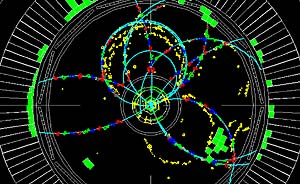 Particle tracks reveal the mysteries of matter
The results partially confirm an announcement made last year that describes the imbalance in these physical opposites. But scientists say their experiments raise yet more questions because the Slac research does not in itself sufficiently explain why there is so much matter in the cosmos - the billions of galaxies full of stars and planets. Short-lived particles The latest announcement was made at an international conference on high-energy physics held in Amsterdam, Holland. Scientists working at Slac gave a precise measurement of a parameter known as sine two beta (0.74 plus or minus 0.07). This expresses the degree of asymmetry between matter and antimatter.
However, the Universe around us is undeniable proof of the victory of matter over antimatter. To find out how this came about, physicists have looked at an effect called Charge Parity (CP) violation. Looking at CP violation involves studying particles, called B mesons and anti-B mesons, which have very short lives - a trillionth of a second. Any difference in behaviour of these otherwise exactly opposite particles indicates a difference between matter and antimatter - and explains why one won out over the other. ' Exquisite accuracy ' The millions of B and anti-B meson events that the physicists needed to hone the accuracy of their measurement were produced in collisions between beams of electrons and their antimatter counterparts, called positrons, in Slac's particle storage rings. "This research at Slac is a wonderful demonstration of the scientific method," said Raymond Orbach, director of the US Department of Energy's Office of Science.
The first results, announced in 2001, gave clear evidence for CP violation in B mesons. "This was a major discovery but much more data were necessary to turn sine two beta into a fundamental constant of particle physics," said Stewart Smith of Princeton University. "The new result for sine two beta comes after three years of intense research and analysis of 88 million events. It is the fruit of tremendous effort from the 500 collaborators," he added. Deeper mystery The new measurement agrees with the so-called Standard Model that explains subatomic particles and their interactions. But the work, in answering one fundamental question, has also uncovered a deeper mystery. The degree of CP violation now confirmed is not enough on its own to explain the matter-antimatter imbalance in the Universe.
"In the future, we will use our experiment to allow us to examine rarer processes and more subtle effects that will give us an even clearer understanding. "This may point us towards the processes which caused our Universe to evolve into its current state. It is a very exciting prospect," he said. | | See also:  05 Mar 99 | Science/Nature 10 Aug 00 | Science/Nature 09 Jul 01 | Science/Nature Top Science/Nature stories now: Links to more Science/Nature stories are at the foot of the page. | ||||||||||||||||||||||||||||||||||||||||||||||||||||||||||||||||||||||||||||||||||||||||||||||||||||||||||||||||||||||||||||||||||||||||||||||||||
| |
|  E-mail this story to a friend E-mail this story to a friend |
| |
| Links to more Science/Nature stories |
| | | ||
 | ||||
 | | Back to top
| ||
| ---------------------------------------------------------------------------------- To BBC Sport>> | To BBC Weather>> | To BBC World Service>> ---------------------------------------------------------------------------------- © MMIII | News Sources | Privacy |