
|
 |
 | | | | | ||||||||||||||||||||||||
| | You are in: Sci/Tech | ||||||||||||||||||||||||||
 | | Sunday, 24 March, 2002, 08:02 GMT Chips to fight kidnapping  Blurring the distinction between man and machine
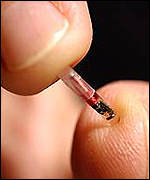
Originally Applied Digital Solutions had intended to market its VeriChip to patients who wanted to keep their medical records under their skin. But recently the firm has caved in to pressure to include tracking devices. "If a market demand exists for an implantable GPS (Global Positioning Satellite) device of some kind, which now seems to be the case, the company will try to meet that demand," said a spokesman for Applied Digital Solutions. "There seems to be a pressing need for this kind of product to stem the tide of kidnappings in Latin America. So we're very interested in responding to this demand and to help save lives," he said. Big Brother worries The VeriChip is not yet available as it is pending US Government approval. But as chip implants designed for medical uses mutate into tracking devices, the debate about how good the technology will be for us is being reopened.
"You can't put the cat back in the bag. It depends on whether governments want to increase surveillance rather than on the technology," he said. For head of Privacy International, Simon Davies, the closer relationship between the body and technology is not a happy one. "The intimacy between technology and the flesh crosses a line," he said. "My instinct tells me this is an entirely unnecessary and dangerous technology." Available technology But some may see tracker chips as a positive development. After 11 September, many western governments have become paranoid about security and want to keep a closer eye on citizens with schemes such as national ID cards. "You can't get a better ID card than one you can put under your skin," points out Mr Pearson. The technology necessary to locate a person geographically is not particularly sophisticated. It has been around for years in the chips that are implanted beneath the skin of pets. Sensational chips But chips are set to get a whole lot more complicated. Chips that monitor blood chemistry are already being made, as are ones that can be connected to the nervous system to allow movement in limbs that have been damaged. The next stage would be making chips that can interpret sensations and connect people that are physically removed from each other. "There is no reason why you couldn't shake hands across a network or make love to your boyfriend," said Mr Pearson. | | See also:  Internet links: The BBC is not responsible for the content of external internet sites Top Sci/Tech stories now:  Links to more Sci/Tech stories are at the foot of the page. | ||||||||||||||||||||||||
|
Links to more Sci/Tech stories |
 | | ^^ Back to top News Front Page | World | UK | UK Politics | Business | Sci/Tech | Health | Education | Entertainment | Talking Point | In Depth | AudioVideo ---------------------------------------------------------------------------------- To BBC Sport>> | To BBC Weather>> ---------------------------------------------------------------------------------- © MMIII|News Sources|Privacy  |


 E-mail this story to a friend