 | Panorama: What has labour done for the NHS? BBC One, Sunday, 20 February 2005, 22:15 GMT |
Professor John Appleby, Chief Economist at the King's Fund, was asked by Panorama to analyse the government's spending plans for the National Health Service (NHS).
His analysis reveals that the price the NHS pays hospitals for treatment will have risen by around 17% in the three years from 2003 to 2005 - assuming hospitals are able to make the efficiency gains the Department of Health has asked of them.
And it suggests that there's a lot less for managers to spend, on new and existing services, than the 7.4% real terms annual increase the government talks about: specifically he calculates it to be an increase of 5% last year, 2.4% this year and 2.2% next financial year.
According to Prof Appleby much of the spending has been ear-marked for rises in basic pay, health service price inflation and changes to working practices, including the costs of new contracts for consultants and family doctors, and implementing guidance on better quality care and drugs from the National Institute for Clinical Excellence (NICE).
Last year, higher pay and the new employment contracts which some NHS organisations say are costing more than expected accounted for a third of the cash rise. Professor Appleby told Panorama:
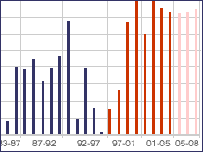
"NHS spending in England has gone up quite considerably over the last 5-6 years by about 10% in cash terms each year. If we take account of inflation generally in the economy then that reduces the rise; so the real rise every year has been something of the order of 7 to 7.5% each year."
"The NHS has its own experience of inflation. It buys doctors, it buys nurses and so on, and their pay and prices go up differently to the general economy. So if you look at that, then the rise has not been so great - it's between, say, 5 and 6 percent in real terms each year."
"But if we look at the last few years, one of the things we have to take account of are cost pressures on the NHS: So what does the NHS have to spend its money on? Things like pay, increases in pay, increases in prices of goods and services that the NHS buys, pension contributions the NHS has to make have gone up, payments for clinical negligence."
| Graph shows spending on the NHS in terms of real percentage change 
|
"When you add all these sort of cost pressures together, that actually reduces the amounts of money left over to spend on reducing waiting times quite considerably. Analysis from the Department of Health seems to suggest that this year, for example, the money spare for the NHS is only around 2 to 3% - 2.5% maybe."
"Now that's considerably different from the 10% extra cash the NHS was given and different from the real rise that ministers talk about of around 7.5 %."
The data is only available now because it's been produced by the Department of Health, as part of setting a new national tariff for treatment the NHS provides- so called Payment by Results, which is being extended to all NHS trusts in 2005-2006.
The table below shows Professor Appleby's calculations, using Department of Health data
| NHS Spending |
| HCHS inflation uplift estimates (used to uprate HRG costs) |
| Year | 2003 - 2004 (*) | 2003 - 2004 | 2004 - 2005 (*) | 2004 - 2005 | 2005 - 2006 (*) | 2005 - 2006 |
| �million | % | �million | % | �million | % |
| Baseline | 37510 | | 41077 | | 46162 | |
| Pay and price inflation | | | | | | |
| Pay | 1425 | 3.80 | 1085 | 2.64 | 1312 | 2.84 |
| Non-pay | included in pay | included in pay | 219 | 0.53 | 257 | 0.56 |
| Clinical negligence | | 0.00 | 183 | 0.45 | 58 | 0.13 |
| Secondary care drugs | 188 | 0.50 | 190 | 0.46 | 199 | 0.43 |
| Revenue cost of capital | 300 | 0.8 | 186 | 0.45 | 105 | 0.23 |
| Expected efficiency gain | -375 | -1.00 | -411 | -1.00 | -785 | -1.70 |
| Reform and quality | | | | | | |
| Consultant contract | 150 | 0.40 | 27 | 0.07 | 200 | 0.43 |
| Agenda for change | | 0.00 | 490 | 1.19 | 460 | 1.00 |
| working time directive | 38 | 0.10 | 70 | 0.17 | | 0.00 |
| NICE guidance | 38 | 0.10 | 304 | 0.74 | 328 | 0.71 |
| Investment in new capital | 72 | 0.20 | 37 | 0.09 | 184 | 0.40 |
| Technical adjustments | | | | | | |
| Pension indexation rebasing | | 0.00 | 1200 | 2.92 | | 0.00 |
| Revaluation of NHS estate | | 0.00 | | 0.00 | 134 | 0.29 |
| Change in discount rate | -675 | -1.80 | | 0.00 | | 0.00 |
| Total (exc efficiency gain) | 1536 | 4.10 | 3991 | 9.72 | 3237 | 7.01 |
| Total (inc efficiency gain) | 1161 | 3.10 | 3580 | 8.72 | 2452 | 5.31 |
| Total cash | 41076 | | 46162 | | 50469 | |
| Cash increase | 3564 | 9.50 | 5086 | 12.38 | 4307 | 9.33 |
| Change allowing for cost and other spending commitments and excluding efficiency gain | 2028 | 5.2 | 1095 | 2.4 | 1070 | 2.2 |
| * 2001/02 ref cost | | * 2002/03 ref cost | | * 2003/04 ref cost | |
| Source: DoH/King's Fund |


 E-mail this to a friend
  Printable version

 When you add all these sort of cost pressures together, that reduces the amounts of money left over to spend on reducing waiting times quite considerably.
 More details


