By Brady Haran
BBC News Online, East Midlands |

 This reporter reveals a source |
BBC News Online is exploring the River Trent with a series of stories "From the Source to the Sea". In his first report, Brady Haran investigates water quality. For such a mighty waterway, the Trent has a humble beginning.
The nation's third longest river - and second largest in terms of water flow - begins as a muddy puddle in Staffordshire.
The "Head of Trent", marked only with an old monument and rusty gate, lies on the edge of a cow paddock in the small village of Biddulph Moor.
From there it trickles down a hill towards Stoke-On-Trent where the first serious pollution enters the river.
In fact, the early stages of the Trent have historically been among the most polluted, causing many problems further downstream.
The River Trent covers 274km and has 42 main tributaries 
|
The River Tame, one of the Trent's early tributaries, is used to drain waste from Birmingham and further adds to the Trent's woes.
As a result, water taken directly from the Trent has not been used as a drinking supply in living memory.
Ruth Needham, from the OnTrent partnership, says: "For many years the Trent has suffered from high pollution levels from sewage discharges and from run-off from agriculture.
"It has not been worth the water company's while to treat it."
However the Trent is a river on the mend, according to the Environment Agency.
Major pollution incidents have fallen from 165 in 1995 to just 64 last year.
Since its worst days in the mid-1960s, overall water quality has also improved along the river and its tributaries.
This improvement is best demonstrated at a place called Witches Oak Waters, just off the A50 near Castle Donington.
The site, managed by water company Severn Trent, is a quarry filled with water from the Trent.
It is being used as back-up water supply for Nottingham and Derby, to be drawn upon if other sources encounter problems.
The supply was recently trialled successfully, marking the first time water from the Trent has been consumed by people in the East Midlands.
 Philip Precey has been spotting more otters |
Severn Trent conservation manager, Geoff Nickolds, says: "We have invested over �2 billion on river water quality improvement in the Trent over the past 10 years or so. "It's now at a standard where we can treat it for drinking water, which it hasn't been for 70 or 80 years or more.
"It's opening up a whole new possibility of supply for us."
In addition to this, Witches Oak is also becoming a site teeming with wildlife, such as birds and otters.
It is the return of otters to the Trent which many conservationists are citing as the best example of the river's recovery.
Philip Precey, from the Derbyshire Wildlife Trust, is a veteran 'otter spotter' and has noticed an increase in spraints (droppings) along the river.
He says: "From the mid 1950s until the end of the 1980s, otters were extinct through virtually all of lowland England, but very much so in the Midlands.
"Since the late 1990s, they have slowly come back, and hopefully back to stay."
The National Otter Survey for England from May last year showed the network of the Trent and its tributaries had the biggest increase of any region in the UK.
Mr Precey says otters are a flagship species to help environmentalists convey their messages.
"If you try to explain to people about wetland conservation, it all sounds a bit wishy washy.
"But if you say to them it's about otters, that's something big and sexy, a big animal... people understand otters and then we can explain all the other things."
Also in our series from the Trent:
 Home
Home


 BBC NEWS CHANNEL
 News services
 E-mail this to a friend
  Printable version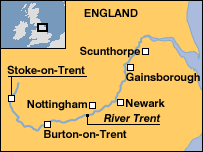
 Enlarge Map

 Otters are something big and sexy... people understand otters


