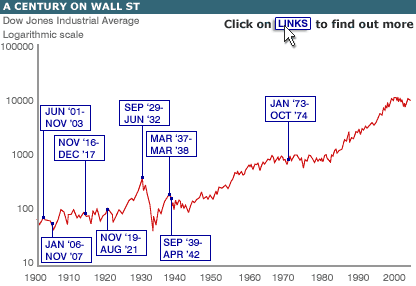
The great Wall Street Crash, exactly 75 years ago, remains the nastiest and most prolonged slump in market history. But during a troubled century, market mayhem occurred with sickening frequency.
BBC News presents a guide to the worst-ever bear markets.
1901-03
- Fall in the Dow: 46%
- Losses recovered by: July 1905
The Dow Jones Industrial Average was only five years old when it fell into its first really severe bear market.
The 1901-03 decline was rare in being one of only three bouts of gloom lasting more than two years - the others were 1939-42 and the great crash of 1929-32. This despondency was caused by a host of nasty incidents, most notably the assassination of President William McKinley in September 1901; later in the year, a particularly severe drought caused genuine alarm about US food supplies.
Although the markets recovered relatively quickly after 1903, the 20 years after 1901 were among the gloomiest in stock market history. US shares returned a total yield for the period of less than zero, giving the lie to the often-heard pronouncement that long-term stock market returns are always healthy.
1906-07
- Fall in the Dow: 49%
- Losses recovered by: September 1916
The US economy took a nasty turn in 1906, largely because President Theodore Roosevelt threatened to clamp down on the monopolies that dominated many business sectors. Railway promoters, in particular, panicked.
Combined with the demands of having financed the Boer and Russo-Japanese wars, Mr Roosevelt's antitrust drive left Wall Street banks in poor shape. By mid-1907, a mood of gloom was turning into full-fledged financial turmoil.
In the absence of any sort of formal stock market regulation, John Pierpoint Morgan, the greatest tycoon of the age, formed an alliance with the government to stabilise the financial system; two large banks, and even the New York Stock Exchange itself, were bailed out.
1916-17
- Fall in the Dow: 40%
- Losses recovered by: November 1919
World War I was an odd time for Wall Street.
The New York Stock Exchange was closed for much of the latter part of 1914, and the shares in the Dow were rejigged mercilessly over the next couple of years. But while the US remained out of the European war, the markets prospered.
The trouble began as Germany started to attack US shipping, and it became likelier that American troops would be dispatched to Europe. On 1 February, the day after Germany withdrew its pledge to safeguard American ships, the Dow lost more than 7% of its value.
1919-21
- Fall in the Dow: 47%
- Losses recovered by: November 1924
The crash of 1919 was the bursting of the first big tech bubble.
Just as the bears pounced when internet shares looked overvalued in 2000, so fears over the viability of the automobile haunted 1919. By then, car ownership was approaching what many commentators said was a natural saturation point: up to 50% in some markets. The reaction was a severe shake-out in the car sector, as well as among other "new economy" companies. Unemployment surged, combining with increasing unrest - even terrorism - among fast-growing immigrant communities.
The market gloom only lifted when it became clear that cars could create new economic opportunities by stimulating road-building, tyre-manufacturing, metal-bashing and so on - activity that could fund a general increase in wealth.
1929-32
- Fall in the Dow: 89%
- Losses recovered by: November 1954
This was the big one: the deepest and longest crash in stock market history.
Although it had some terrible moments, the great Wall Street crash did not, however, have the worst day's trading in history: far worse were 12 December, 1914 - when the Dow lost 24% of its value - and 19 October, 1987 - a 22% loss. Most notable, however, is the sheer length of time - 22 years - taken to recover the losses after September 1929. The recovery was so long, in fact, that it contained two other highly unpleasant bear markets and recoveries.
1937-38
- Fall in the Dow: 49%
- Losses recovered by: December 1945
After the bubbles and turmoil of previous bear markets, 1937-38 seems rather dull.
Its cause was a plain old-fashioned recession, an after-shock of the more severe slump endured by the US and Europe at the beginning of the 1930s. Governments in Europe accentuated the gloom by raising taxes to spend on re-arming, while the US Government poured extra money into its New Deal, a programme intended to stimulate the economy and raise employment.
Disillusionment among the business community was by then so strong, however, that the New Deal was abandoned soon after.
1939-42
- Fall in the Dow: 40%
- Losses recovered by: January 1945
Since this crash began in 1939 and was healed by 1945, it's not hard to guess its cause.
Although Wall Street could observe World War I with equanimity in 1915, it could not be so relaxed in 1939: American interests in Europe were far too deep for that. During the war, the Dow closely followed the fortunes of the allied forces, rallying in late 1940 as Britain fought off invasion.
And unlike in 1917, there was no market mayhem when the US entered the war, something that had been factored in by investors almost from the start.
1973-74
- Fall in the Dow: 45%
- Losses recovered by: December 1982
The 1973-74 bear market - the only truly severe slide after World War II - came after a prolonged bout of optimism.
In 1972, after Richard Nixon's re-election, the Dow had exceeded 1,000 points for the first time ever. The reverse came among a veritable landslide of bad news, including the Watergate scandal, an Arab-Israeli war and most particularly an oil embargo that sent fuel prices through the roof.
High oil prices produced a recession, ensuring that the gloom persisted well beyond the political factors that sparked the market collapse; even Mr Nixon's resignation in August 1974 did nothing to cheer investors.


 One-Minute World News
  News services

 E-mail this to a friend
  Printable version


